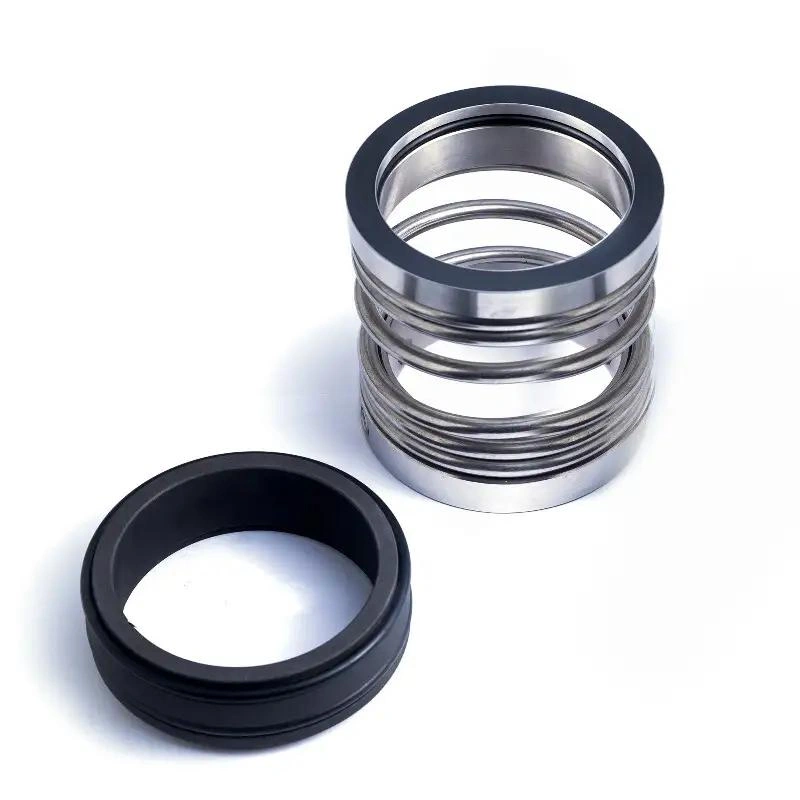

Do you know what a balanced mechanical seal is? It is a smarter and more durable sealing part used in industrial equipment.It is designed for medium- and high-pressure systems, helping reduce seal wear, leakage, overheating, and damage.Unlike an unbalanced seal, it uses a special structure to reduce the pressure pushing directly on the sealing faces.
This makes it a reliable choice for pumps and fluid equipment, helping extend seal life, improve stable operation, and reduce failures and unplanned shutdowns.In this guide, we will explain how balanced mechanical seals work, where to use them, and the common problems you may face.
Do you know what a balanced mechanical seal is? Simply put, it is designed to reduce the fluid pressure acting on the sealing faces.It changes the effective pressure area, so the sealing faces are not pressed together too tightly by the fluid pressure.This helps you reduce friction, heat, and seal face wear while keeping enough closing force to control leakage.
A balanced mechanical seal is more suitable for pumps working under higher pressure.When system pressure is high, an unbalanced seal may be pressed too tightly, causing faster wear and leakage.By choosing a balanced mechanical seal, you can reduce these problems and help your equipment run more reliably for a longer time.
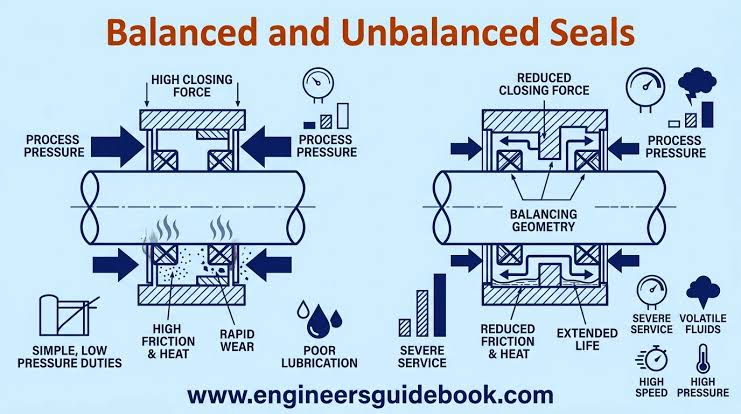
Do you know how a balanced mechanical seal works? The principle is actually easy to understand.It uses steps on the sleeve and rotating ring to change the pressure area, so fluid pressure does not act fully on the sealing faces.Simply put, you can think of it as reducing extra pressure and keeping the balance ratio below 1 to lower the face load.
When your equipment runs, the seal structure offsets a large part of the fluid pressure.As a result, only part of the pressure acts on the contact area between the rotating and stationary seal faces.This keeps the contact pressure more even and controlled, instead of rising sharply when system pressure increases.With lower face pressure, you can reduce friction, heat, and wear while keeping a stable lubricating film between the seal faces.
This helps prevent high pressure from squeezing out the liquid film and causing dry running and seal face damage.At the same time, the seal can still control the fluid and prevent leakage effectively.As a result, you can improve seal reliability and help extend the service life of both the seal and the equipment.
Do you know what the balance ratio is? It is an important value used to show how much hydraulic pressure acts on the seal faces.You can understand it with this formula:Balance Ratio (B) = Hydraulically Loaded Area (Ah) ÷ Seal Face Area (As)
Here, Ah is the effective area where fluid pressure creates closing force on the seal faces.As is the contact area between the rotating and stationary seal faces.For example, if the hydraulic area is 600 mm² and the seal face area is 800 mm²:B = 600 ÷ 800 = 0.75
You can simply understand it this way: the lower the balance ratio, the less strongly fluid pressure pushes the two seal faces together.In common designs, B < 1 usually means a balanced mechanical seal, while B > 1 usually means an unbalanced seal.Balanced seals often use a ratio around 0.6 to 0.8, but the correct value depends on the seal design and operating conditions.However, you should not assume that a lower balance ratio is always better.
A lower ratio can reduce face load, friction, and heat, while helping maintain the lubricating film between the seal faces.If the ratio becomes too low, leakage may increase, and the seal faces may even separate.So, when you select a seal, you need to balance face load, lubrication, heat, leakage, and operating stability.You should not simply choose the lowest possible balance ratio.
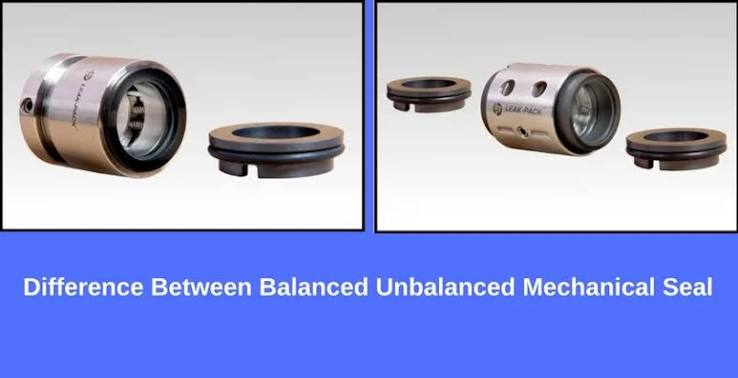
Do you know the difference between balanced and unbalanced mechanical seals? From the outside, you may find that both designs look very similar.Both usually include a rotating ring, stationary ring, spring, and secondary seals.However, their internal pressure design is very different. This is the main reason they are suitable for different operating conditions.An unbalanced mechanical seal has a simpler structure, without a balance step or special pressure-reducing design.
Its sleeve and rotating ring usually have a more direct structure, allowing fluid pressure to act strongly on the sealing faces.As pressure increases, the rotating and stationary faces are pushed together more tightly.You can understand it as a passive design: higher system pressure usually creates higher closing force on the seal faces.A balanced mechanical seal adds an important structural change called a balance step.
This step changes the effective pressure area and reduces how much fluid pressure acts on the sealing faces.You can think of this small structural change as giving the seal a way to reduce extra face load.Instead of allowing all pressure to push directly on the rubbing faces, the balanced design reduces part of the hydraulic load.As a result, the contact pressure between the seal faces becomes lower and easier to control.
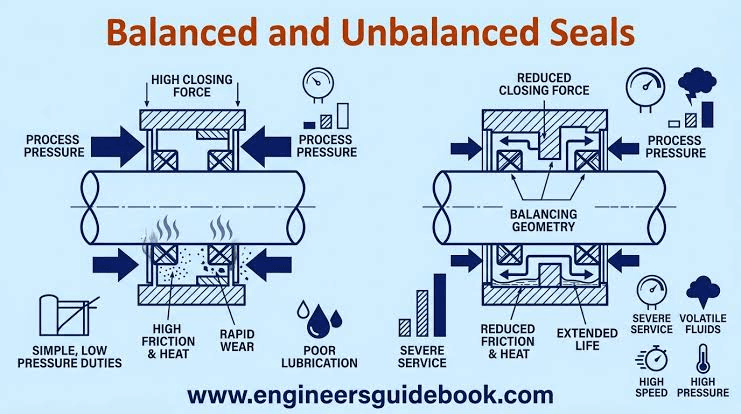
Do you know the biggest advantage of a balanced mechanical seal? It can reduce the hydraulic load acting on the sealing faces.When you use a high-pressure pump, an unbalanced seal may press the faces too tightly, causing more friction and heat.A balanced design can reduce these problems and help the seal work more smoothly.
However, you should not assume that a balanced mechanical seal is always better than an unbalanced seal.You still need to consider pressure, speed, temperature, fluid type, and equipment design before choosing the right seal.
You should know that balanced mechanical seals handle pressure well, last longer, and perform strongly under high-pressure conditions.However, they are not the best choice for every application. You still need to compare their limits with your actual operating conditions.
In engineering selection, you should not choose the “best” seal. You should choose the seal that best matches your operating conditions.If pressure is low and conditions are mild, an unbalanced seal may be the better choice.It is simpler, cheaper, easier to install, and often enough when occasional maintenance is acceptable.If pressure, speed, or temperature is high, or lubrication is poor, a balanced seal may be more suitable.
You may pay more at first, but you can gain lower wear, fewer failures, longer service life, and lower maintenance risk.This is especially useful when your equipment cannot stop easily and unexpected shutdowns would cause higher production losses.So, when you choose a balanced mechanical seal, do not only ask whether it is more advanced.You should ask whether lower face load truly matches your pressure, speed, fluid, temperature, and equipment operating conditions.
In real engineering applications, you do not need a balanced mechanical seal for every machine.You usually choose one when a standard seal cannot handle the conditions, wears too quickly, or causes repeated problems.
You should pay special attention to critical equipment where leakage, shutdowns, or unstable operation cannot be accepted.In these cases, you should use a balanced mechanical seal to improve sealing stability and reduce the risk of failure.
Although the initial cost is slightly higher, you can gain more stable performance, fewer failures, and lower losses from unexpected shutdowns.For critical equipment, this makes a balanced seal a safer and more reliable engineering choice.
Do you know the typical applications and fluids for balanced mechanical seals?Balanced mechanical seals are often used in equipment with higher pressure, higher speed, higher temperature, or stricter sealing requirements.You can often find them in the following equipment:
These machines often run for long periods, and shutdowns can be costly.For this reason, you usually need more stable and reliable sealing performance.Balanced mechanical seals are also commonly used with these fluids:
However, you should not choose a balanced mechanical seal only by looking at the fluid name.You also need to check pressure, temperature, speed, lubrication, corrosion, solid particles, and the actual operating conditions inside the seal chamber.
When you choose between a balanced and unbalanced mechanical seal, you should not look at only one factor.
Pressure, speed, temperature, and fluid lubricity work together to affect face load, friction heat, and the lubricating film.Pressure is one of the most important factors when you decide whether a balanced mechanical seal is needed.As seal chamber pressure increases, the hydraulic closing force on the seal faces also increases.If the faces are pressed too tightly, you may see more friction, heat, and wear.A balanced seal reduces the effective pressure area and lowers face load, making it better suited for higher-pressure conditions.
Speed is another important factor you should consider.As speed increases, the seal faces move faster, create more heat, and require a more stable lubricating film.At low speed, operating conditions are usually milder, so a standard seal may be enough.At high speed, the faces are more likely to suffer from heat, dry running, and faster wear.A balanced seal can reduce face load and friction, making it more suitable for long-term continuous operation at higher speeds.
Temperature also affects your seal selection.At normal temperatures, standard seal designs can often meet your needs without special pressure-reducing features.High temperatures can lower fluid viscosity, weaken the lubricating film, and speed up the aging of secondary seals.When high temperature and high pressure occur together, the seal faces face much harder operating conditions.A balanced seal keeps face pressure more controlled and friction more stable, helping you reduce wear and failure risks under high-temperature conditions.
Finally, you should pay close attention to fluid lubricity, because this factor is often overlooked during seal selection.Fluids such as lubricating oil and heavy oil provide better lubrication and help protect the seal faces from friction.Fluids such as water, wastewater, and light solvents usually provide less lubrication than oils.With these fluids, a standard seal may face a higher risk of dry friction, wear, and leakage.
A balanced seal lowers face pressure and helps maintain a more stable liquid film between the sealing faces.This can help you reduce problems caused by poor lubrication and improve the operating stability of your equipment.
When you choose a balanced mechanical seal, you should also pay attention to an important factor called PV Loading.It helps you judge whether the working load on the seal faces is too high.A higher PV value means a heavier working load, which usually brings more friction, heat, and wear.For this reason, you need to choose the right face-material pairing to handle the load and reduce seal failures.
When PV loading is low, the seal faces work under lighter conditions, so common material combinations are often enough.For example, carbon graphite paired with tungsten carbide offers reasonable cost, good sliding performance, and stable operation for many standard pump applications.
When PV loading increases, common material combinations may face overheating and faster wear.Under severe conditions, you may even see surface damage, sticking, or burned seal faces.In these cases, you may need stronger face combinations, such as tungsten carbide against tungsten carbide.Tungsten carbide offers high wear resistance and good strength, making it suitable for heavier PV loading when the operating conditions support this pairing.
In a balanced mechanical seal, the balanced design reduces the actual closing pressure on the seal faces.You can understand this as indirectly reducing the effective PV load on the sealing surfaces.However, you should never judge seal performance by PV loading alone.
Even when PV is not very high, poor lubrication or solid particles in the fluid can still increase face wear.So, when you select a seal, you should consider pressure, speed, fluid condition, and PV loading together.This helps you choose the right face-material combination without adding unnecessary cost.
When you choose a balanced mechanical seal, you should also consider vapor pressure, cooling conditions, and the flush system.Even if the seal is selected correctly, it may still fail quickly if the fluid near the seal faces begins to vaporize.Under vapor-prone conditions, the fluid may flash into vapor when local pressure drops.
Once this happens, the lubricating film between the seal faces can disappear quickly.Without this liquid film, you may see dry friction, rapid heating, and serious damage to the seal faces.A balanced mechanical seal can reduce face load and friction heat, but it cannot remove all heat.
If your fluid is already very hot, extra friction heat can raise the local temperature even further.As temperature increases, the fluid may vaporize more easily, and its lubricating ability may also become weaker.For high-temperature fluids, you can use cooled circulation to improve the environment around the seal faces.This helps you control temperature, support lubrication, and reduce the risk of vaporization and seal damage.
When you request a quote or select a mechanical seal, you should not only provide the pump model or say you need a balanced seal.To choose the right seal design, balance ratio, face materials, and support system, you should provide the following information:
When you buy a mechanical seal, you are not simply buying a replacement part.You should give your supplier complete operating information so they can match the seal to your actual working conditions.The more complete your data is, the easier it becomes to avoid the wrong seal selection and reduce equipment problems.This helps you get a seal that better fits your application and supports more reliable equipment operation.
When you choose a balanced mechanical seal, you should also check equipment dimensions and the allowed operating range.These two factors determine whether the seal truly fits your equipment.
First, you need to confirm the shaft or sleeve diameter.The rotating seal part is installed on the shaft or sleeve, so incorrect dimensions may cause installation problems, misalignment, or leakage.You should usually confirm:
Next, you need to check whether there is enough space inside the seal chamber.You should normally check:
If the seal is too large or too long, you may not be able to install it even when its performance is suitable.
You should also check the gland dimensions.This includes the gland diameter, bolt-hole positions, mounting dimensions, and flush or cooling connections.These dimensions are especially important when you replace an existing seal with a balanced mechanical seal.The new seal must match the existing equipment connections.
You should also know the safe operating range of the mechanical seal.This operating range usually includes:
The mechanical seal must operate within this range to maintain proper face contact, lubrication, and cooling.Before purchasing, you should provide installation dimensions, shaft size, seal chamber dimensions, pressure, temperature, speed, and fluid conditions.You should not provide only the pump model when requesting a mechanical seal.
You should also check the gland dimensions.This includes the gland diameter, bolt-hole positions, mounting dimensions, and flush or cooling connections.These dimensions are especially important when you replace an existing seal with a balanced mechanical seal.The new seal must match the existing equipment connections.
You should also know the safe operating range of the mechanical seal.This operating range usually includes:
The mechanical seal must operate within this range to maintain proper face contact, lubrication, and cooling.Before purchasing, you should provide installation dimensions, shaft size, seal chamber dimensions, pressure, temperature, speed, and fluid conditions.You should not provide only the pump model when requesting a mechanical seal.
When you choose a balanced mechanical seal, you should not only check pressure, temperature, and speed.Fluid properties also affect face materials, secondary seal materials, and whether you need an additional Seal Support Plan.
First, you need to understand what fluid will actually contact the mechanical seal.You should usually confirm:
These factors affect face wear, vaporization risk, material corrosion, and whether small amounts of leakage can be accepted.Different fluids also require different seal face combinations.Common face materials include:
You should also know that a balanced design mainly reduces hydraulic load on the seal faces.It cannot automatically solve problems caused by high temperature, particles, vaporization, poor lubrication, or hazardous fluid leakage.In these cases, you may need a Seal Support Plan.A Seal Support Plan can use circulation, flushing, cooling, pressure control, or barrier fluid to create better operating conditions for your seal.
You use process fluid from the pump discharge and return it to the seal chamber for flushing and cooling.It is usually suitable for relatively clean fluids that can lubricate the seal faces.
You circulate and cool fluid around the seal chamber through a separate loop.This plan is more suitable when you need better control of seal temperature.
You use a clean external fluid to flush the seal area.You may consider this plan when the process fluid is dirty, has poor lubrication, or should not directly contact the seal faces.
Not necessarily. If you use a properly designed and installed balanced mechanical seal, it does not automatically leak more.Leakage also depends on face flatness, balance ratio, pressure, temperature, liquid film, installation accuracy, materials, and equipment condition.
Yes. You can use a balanced mechanical seal at low pressure if the operating conditions stay within the seal’s allowed working range.A balanced seal is not limited to high-pressure applications.
—— We Will Provide You With Professional OEM Solutions.
Whether you require pump bearings, pump valves, mechanical seals, or other custom-engineered components, we support production based on your drawings as well as rapid prototyping.
Please complete the form on the right and upload your technical drawings or specifications. Our engineering team will review your requirements within 24 hours and provide a detailed quotation, application recommendations, and delivery schedule.
Copyright © 2025 Sakowit, All rights reserved.
WhatsApp us