
Do you know what check valve cracking pressure is?Check valve cracking pressure is the minimum pressure needed to push the valve disc open and allow fluid to flow through the pipeline.If the pressure is too low, the valve stays closed. Once the required pressure is reached, the disc opens and allows fluid to pass.
Cracking pressure directly affects whether a check valve can work properly in a real piping system.You should also remember that check valve cracking pressure is not the same as pressure drop.Next, I will explain common check valve cracking pressure problems and how to solve them.
Do you know what check valve cracking pressure really means?Simply put, cracking pressure is the minimum fluid pressure needed to push the valve disc away from the seat and allow flow through the pipeline.When the pressure difference is too low, the disc stays tightly against the valve seat and keeps the valve closed.
Once the upstream and downstream pressure difference reaches the set cracking pressure, the disc begins to lift and fluid can flow forward through the valve.One thing to remember is that if the cracking pressure is too high, flow resistance increases.
If the cracking pressure is too low, the valve disc may shake, open and close repeatedly, or hit the valve seat.Therefore, you should choose the right cracking pressure for your actual operating conditions. This helps the check valve operate more smoothly and reliably.
Do you know how check valve cracking pressure works?Simply put, cracking pressure controls when a check valve opens and closes.When the forward pressure difference rises above the set value, the disc lifts and fluid flows through the valve.
When the pressure difference falls below the set value, the disc moves back to the seat and closes the pipeline.You can understand cracking pressure in three stages:
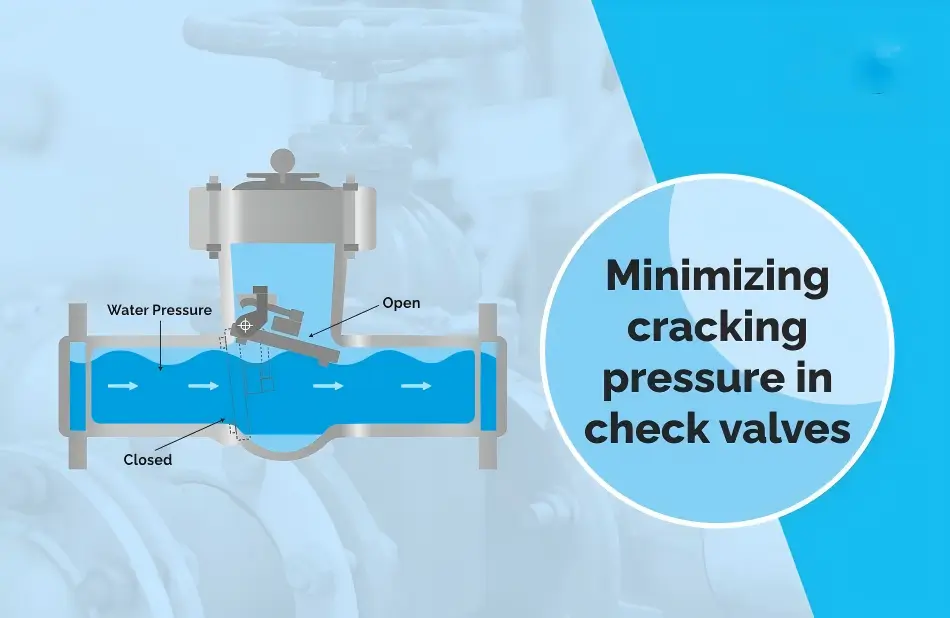
You should remember that reaching the cracking pressure does not mean the check valve is fully open.The valve usually needs a higher pressure difference to open further and allow the required flow rate.
You may wonder whether check valve cracking pressure can be calculated as one fixed value.In fact, there is no single formula that works for every check valve. Different check valve types require different calculation methods.
One important point is that theoretical calculations only provide a reference range.In real systems, flow velocity, fluid temperature, and valve installation position can all affect the actual cracking pressure.
Therefore, you should not rely only on calculated values.You should also check the actual operating conditions and make adjustments or tests when needed
You should clearly understand that these terms are all related to pressure, but they describe very different valve conditions and functions.The table below can help you compare them more easily.
| Parameter | Meaning | Simple Definition | When Does It Happen? | What Does It Mean for a Check Valve? |
|---|---|---|---|---|
| Cracking Pressure | Opening / Start-to-Open Pressure | The minimum forward pressure difference needed to make the disc just leave the valve seat. | When the valve starts opening from the closed position. | It decides when the valve begins to open. |
| Opening Pressure | Valve Opening Pressure | The pressure difference needed to open the disc further to a certain position. | After the valve has already started opening. | It is usually higher than cracking pressure. The exact definition depends on the manufacturer. |
| Pressure Drop | Pressure Loss / Pressure Drop | The pressure lost between the valve inlet and outlet while fluid flows through the valve. | When fluid is flowing through the valve. | It shows how much flow resistance the valve creates. |
| Reseal Pressure | Resealing / Closing Pressure | The pressure condition at which the disc returns to the seat and seals again. | When flow drops, stops, or begins to reverse. | It decides when the valve closes again and restores sealing. |
| Backpressure | Backpressure | The downstream pressure acting on the outlet side of the check valve and resisting forward flow. | It may exist during normal system operation. | Higher backpressure usually requires higher upstream pressure to create enough opening pressure difference. |
Simply put, Cracking Pressure tells you when the valve starts to open.Opening Pressure tells you how much pressure is needed to open the valve further.Pressure Drop tells you how much pressure is lost while fluid flows through the valve.
Reseal Pressure tells you when the valve closes again and restores sealing.Backpressure comes from the downstream side and affects both valve opening and closing.
You should remember that the cracking pressure shown on a check valve nameplate is only an ideal value.In a real piping system, many factors can change the pressure at which the valve actually starts to open.So, what factors affect check valve cracking pressure?
| Factor | Effect on Cracking Pressure | Simple Explanation |
|---|---|---|
| Spring Preload | Higher preload usually increases cracking pressure. | More pressure difference is needed to push the valve disc open. |
| Spring Stiffness | It affects the force needed as the disc continues to open. | A stiffer spring usually creates more resistance during opening. |
| Effective Disc Area | A larger area creates more opening force at the same pressure difference. | A larger pressure area usually makes the disc easier to move. |
| Disc Weight | It has a stronger effect on gravity-operated check valves. | A heavier disc may need more opening force in some installation positions. |
| Valve Installation Direction | Horizontal and vertical installation may change opening behavior. | The direction of gravity acting on the disc changes. |
| Seat and Seal Friction | Higher friction may increase the actual cracking pressure. | The disc must first overcome resistance from the sealing surfaces. |
| Downstream Backpressure | Higher backpressure makes it harder to create enough forward pressure difference. | Higher upstream pressure may be needed to open the valve. |
| Fluid Properties | Density and viscosity can affect valve movement. | Water, oil, and gas may cause different opening behavior. |
| Fluid Temperature | Temperature can change fluid viscosity and the behavior of seals and springs. | The actual cracking pressure may change as temperature changes. |
| Manufacturing Tolerances and Wear | They can cause differences between actual and designed values. | Small differences in springs, discs, and seats can affect opening pressure. |
Therefore, you should not look only at the cracking pressure listed in the product catalog.For demanding systems, you should also consider installation direction, fluid type, and actual operating conditions.This helps confirm whether the check valve can open and close smoothly and reliably.
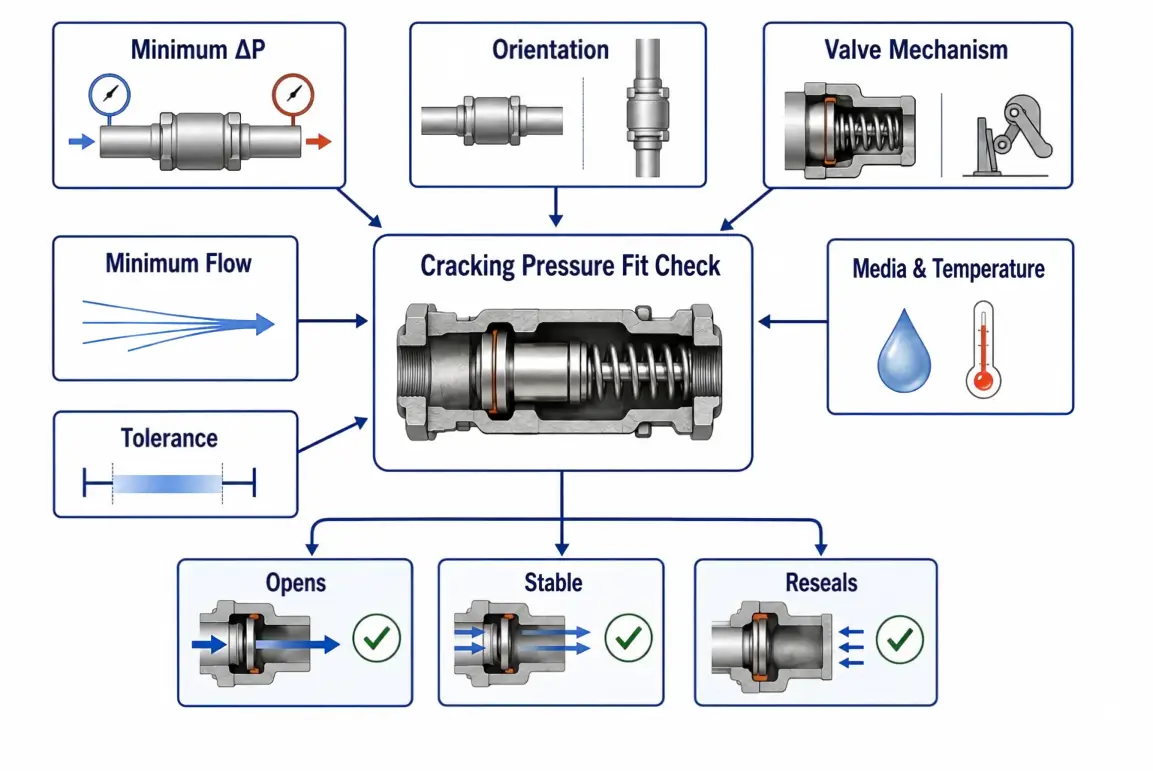
Check valve cracking pressure is important because it directly determines when the valve starts to open and whether the system can maintain normal flow.With the right cracking pressure, the disc opens smoothly when water flows and closes quickly when the flow becomes weaker.
If the cracking pressure is too high, normal flow may not open the valve properly. This increases flow resistance and energy use.If the cracking pressure is too low, small pressure changes may cause the disc to shake and repeatedly hit the valve seat.
This can create noise and wear. In serious cases, it may also increase water hammer.Therefore, you need to choose the right cracking pressure for your system.This allows the valve to open smoothly when needed and close quickly when flow drops or backflow occurs, keeping the piping system more stable.
If the check valve cracking pressure is too high, it can directly affect valve opening, flow rate, and the efficiency of the entire piping system.It may also cause the following problems:
Therefore, the cracking pressure should match the available pressure difference, flow rate, and actual operating conditions of the system.You should not simply choose a check valve with a higher cracking pressure.
Do you know what can happen if the check valve cracking pressure is too low?Here are some common problems you can use as a reference:
Therefore, you should remember that lower cracking pressure is not always better.The right cracking pressure should let the valve open easily when needed.It should also keep the valve stable during low flow, pressure changes, or reverse pressure.
When selecting the right check valve cracking pressure, you should not simply choose a value from the nameplate.You should consider the actual operating conditions of the entire system.The following factors are especially important:
| Selection Factor | What Should You Check? | Effect on Cracking Pressure Selection |
|---|---|---|
| Available Pressure Difference | How much pressure difference is available between upstream and downstream during normal operation? | Cracking pressure must be lower than the forward pressure difference the system can provide steadily. |
| Minimum Flow Rate | What is the lowest flow rate in the system? | Even at low flow, there should be enough force to keep the valve open steadily. |
| Normal Operating Flow | What flow range does the valve usually work in? | The disc should not stay at a very small opening for long periods. |
| Downstream Backpressure | Is there constant pressure on the outlet side? | Higher backpressure leaves less forward pressure difference available to open the valve. |
| Fluid Type | Is the fluid water, oil, gas, or another medium? | Different density and viscosity can change how the valve opens. |
| Installation Direction | Is the valve installed horizontally or vertically? | Gravity may change the force needed to open the disc. |
| Valve Design | Is it spring-loaded, swing, lift, or another type? | Different designs need different opening forces and pressure differences. |
| Pressure Changes | Does system pressure change often? | Systems with frequent pressure changes should avoid repeated valve opening, closing, and shaking. |
| Closing Requirements | Does the valve need to close quickly and prevent backflow? | You should consider both easy opening and stable closing. |
For systems with demanding operating conditions, do not choose a valve only by the cracking pressure listed in the catalog.You should also check the manufacturer’s flow and pressure-drop data and compare it with the actual system conditions.
When selecting check valve cracking pressure, it is easy to make common mistakes that may cause problems during later pipeline operation.The table below shows the most common mistakes when selecting check valve cracking pressure:
| Common Mistake | Why Is It a Problem? | Possible Result |
|---|---|---|
| Thinking Lower Cracking Pressure Is Always Better | Very low pressure makes the disc too sensitive to small pressure changes. | Disc shaking, frequent opening and closing, noise, and wear. |
| Thinking Higher Cracking Pressure Is Safer | The system may not have enough pressure difference to open the disc. | Difficult opening, low flow, and higher energy use. |
| Confusing Cracking Pressure with Pressure Drop | They describe different valve conditions. | The system pressure requirement may be judged incorrectly. |
| Only Checking Inlet Pressure | Valve opening mainly depends on the pressure difference between upstream and downstream. | High backpressure may still prevent the valve from opening. |
| Ignoring Minimum Flow | At low flow, the force on the disc may be too small. | Small valve opening, disc shaking, or repeated closing. |
| Selecting Only by Maximum Flow | The system does not always operate at maximum flow. | The valve may become unstable at low load. |
| Ignoring Downstream Backpressure | Backpressure reduces the forward pressure difference available to open the valve. | The valve may be harder to open than expected. |
| Ignoring Installation Direction | Gravity affects different valve designs in different ways. | Actual cracking pressure may differ from the expected value. |
| Ignoring Fluid Type and Temperature | Viscosity, density, and seal performance may change. | Actual opening behavior may differ from test conditions. |
| Only Looking at One Catalog Value | Catalog values are usually based on specific test conditions. | Actual field performance may differ from the rated value. |
You should know that there is no single cracking pressure that works for every system.Avoid these common mistakes and consider flow, sealing, and pressure impact together.This helps the check valve operate more safely, smoothly, and reliably.
Yes, but it depends on the check valve design.Many standard check valves have a fixed cracking pressure set at the factory.You should not adjust it yourself because this may affect sealing, flow, and closing performance.
If your system needs a special cracking pressure, tell the manufacturer your pressure, flow rate, fluid type, and installation direction before ordering.The manufacturer can then select or adjust the valve to match your operating conditions.
To test cracking pressure, fluid is usually sent through the valve in the correct flow direction.The inlet pressure is then slowly increased until the valve disc just begins to open.
The cracking pressure listed in a product catalog is usually measured under specific fluid, temperature, and installation conditions.In a real piping system, many factors can change the actual pressure at which the valve begins to open.
Choosing the correct check valve cracking pressure is not about finding the highest or lowest value.The key is to match the cracking pressure to your actual piping system.Before selecting a valve, check the actual pressure difference, minimum and normal flow, downstream backpressure, fluid type, temperature, installation direction, and valve design.
If you are unsure which cracking pressure to choose, send us your fluid type, pipe size, flow rate, upstream and downstream pressure, installation direction, and temperature.We can help you select a more suitable check valve and cracking pressure for your system.
—— We Will Provide You With Professional OEM Solutions.
Whether you require pump bearings, pump valves, mechanical seals, or other custom-engineered components, we support production based on your drawings as well as rapid prototyping.
Please complete the form on the right and upload your technical drawings or specifications. Our engineering team will review your requirements within 24 hours and provide a detailed quotation, application recommendations, and delivery schedule.
Copyright © 2025 Sakowit, All rights reserved.
WhatsApp us