
Do you know why water hammer occurs in a check valve? The reason is simple: improper valve closing can easily cause water hammer.If the valve closes too quickly, the water flow stops suddenly and creates a pressure shock.
If the valve closes too slowly, reverse flow develops. The valve disc then slams against the seat, creating the same water hammer pressure.How can you reduce the risk of water hammer? Next, I will explain its common signs and how you can prevent it.
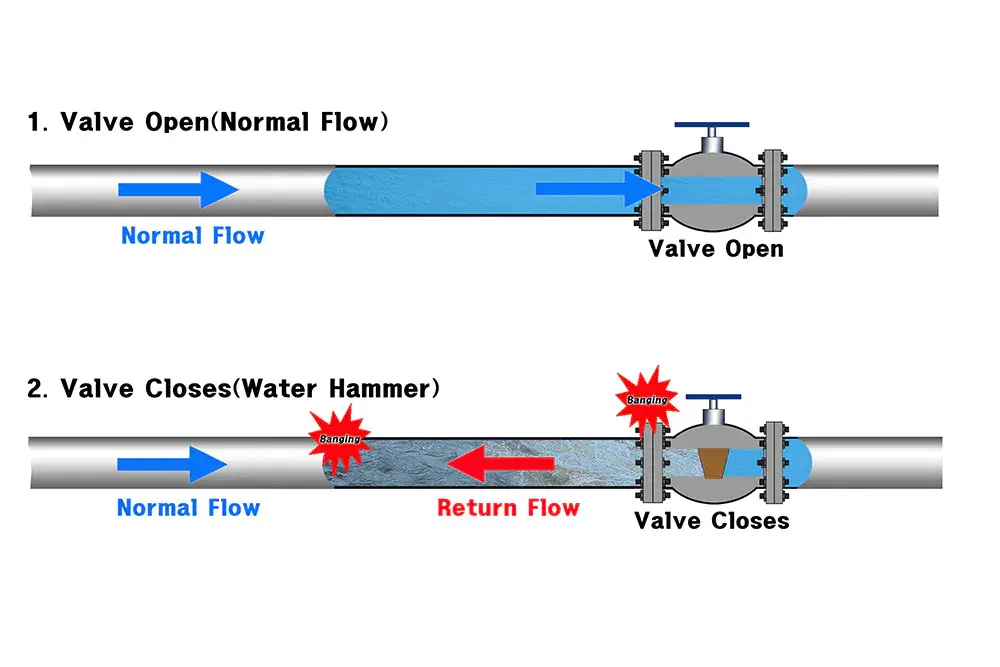
Do you know exactly what water hammer is?Simply put, it happens when flowing liquid in a pipe is suddenly stopped by pump starts, pump stops, or a fast-closing valve.
The moving liquid cannot release its momentum, so it creates a very high pressure shock in an instant.This pressure repeatedly hits the valve, pipe walls, and fittings like a hammer. This is what we commonly call water hammer.
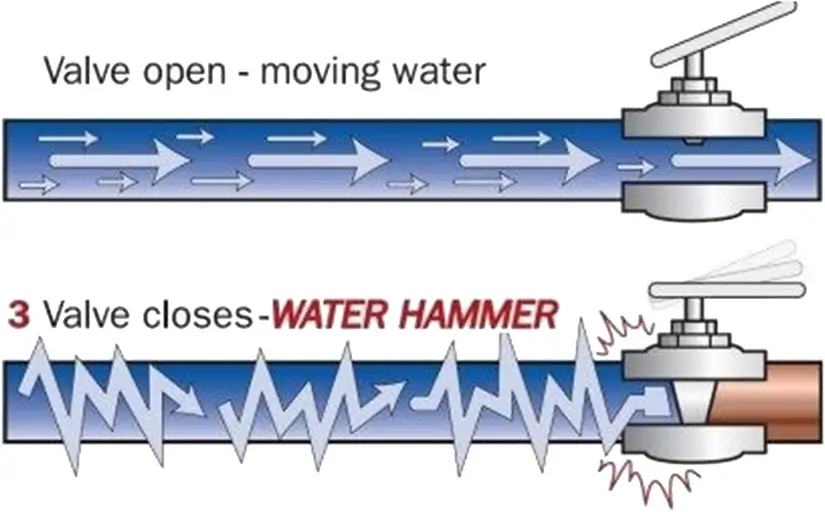
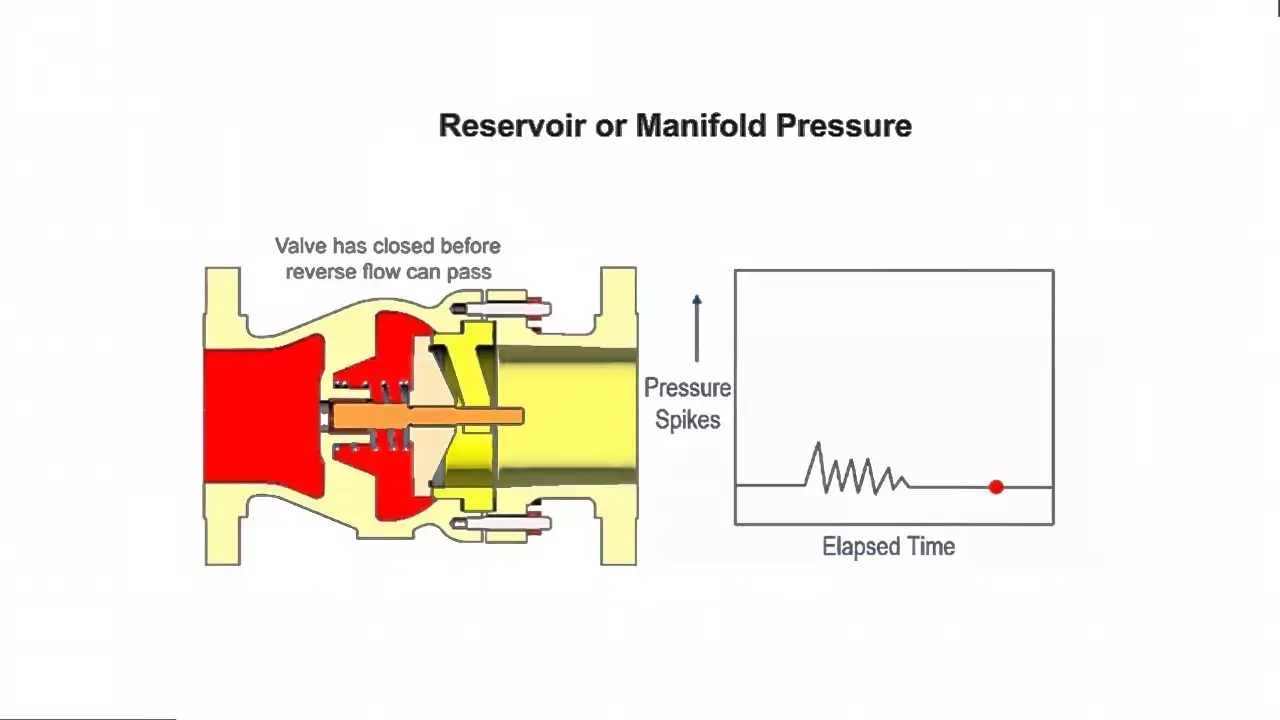
Check-valve water hammer may seem confusing.You should know that a check valve is designed to protect the pipeline by preventing fluid from flowing backward.However, its opening and closing action can also trigger water hammer.If the valve closes too quickly, the moving fluid cannot release its momentum.
This creates a strong pressure shock inside the pipeline and causes water hammer.If the valve closes too slowly, a large amount of fluid may already have flowed backward.The valve disc then slams against the seat, creating the same powerful water hammer pressure.
Repeated impacts gradually shorten the service life of system components.In serious cases, they may damage the seals or loosen pipe connections.Therefore, when selecting a check valve, do not only consider whether it can prevent backflow.You should also pay attention to how the valve closes.A slow-closing design can soften the change in flow and reduce damage caused by water hammer.
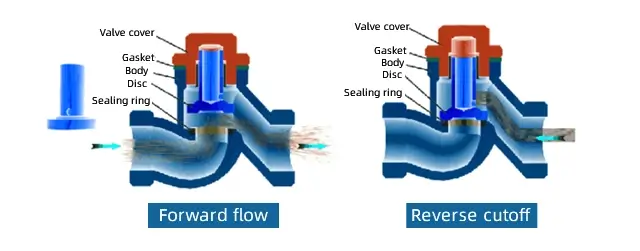
You may easily confuse check valve slam with water hammer, but they are not exactly the same.Check valve slam is a mechanical impact caused when reverse flow drives the valve disc hard against the valve seat.It creates a clear, loud banging sound that you can hear and sometimes feel near the valve.
Water hammer is a pressure wave caused by the momentum of moving water.It travels through the pipeline and can impact pipes, pumps, valves, and other fittings.The table below shows you the main differences:
| Comparison | Check Valve Slam | Water Hammer |
|---|---|---|
| Type of Event | Mechanical impact between the disc and seat | Pressure shock caused by a sudden change in fluid speed |
| Main Location | Mainly occurs inside the check valve | Pressure waves can travel throughout the piping system |
| Common Sound | A clear banging sound near the valve | Knocking sounds may occur at several points in the pipeline |
| Main Cause | The disc closes too late or too quickly | The water flow suddenly stops or changes direction |
| Main Damage | Wear of the disc, seat, and internal parts | Pressure damage to pipes, joints, pumps, and valves |
You should understand that water hammer in check valves is rarely caused by one problem alone.It is usually the result of changes in water flow combined with improper valve movement.What are the main causes of water hammer in check valves?Below are the main causes I have listed for your reference:
I also want to remind you that reducing water hammer requires a complete system check.You should inspect the actual flow rate, pipe velocity, pump shutdown method, valve size, valve type, installation position, and internal condition.
Do you know why pump shutdown can cause water hammer in a check valve?The reason is simple.When the pump runs normally, water moves steadily forward through the pipe.The flowing water pushes the check valve disc open, allowing the system to operate smoothly.
When the pump suddenly stops, the driving force disappears immediately.The forward-moving water loses its push and begins flowing backward because of gravity and pressure differences inside the pipeline.The momentum of the water combines with the closing movement of the check valve.
Together, they create a high risk of water hammer inside the pipeline.You can understand this process through the following stages:
To reduce this risk, the check valve should close before the reverse flow becomes too fast.You can choose a check valve with shorter closing travel, a lighter disc, or a spring-assisted closing design.
You should know that different check valve designs can behave very differently under the same pipeline conditions.The internal valve structure largely determines how strong the water hammer will be.
A well-designed check valve can close smoothly before significant reverse flow begins.Below are the main design features you should consider to help reduce water hammer:
Not every check valve will cause water hammer.Choosing the right design allows the valve closing speed to match the momentum of the water inside the pipeline.This can reduce pressure shocks and help the piping system operate safely and smoothly.
Different check valve designs respond differently to reverse-flow impact. Some types are naturally more likely to cause water hammer.Do you know which check valves have a higher risk of water hammer?Traditional swing check valves have heavy discs and close slowly. After reverse flow begins, the disc may slam against the seat and cause water hammer.
A check valve with an overly strong spring may close too quickly. It suddenly stops the water flow and can also create water hammer.Check valves with slow-closing damping systems can soften the closing movement and effectively reduce the risk of water hammer.When selecting a check valve, you should pay close attention to its design and operating characteristics.
Avoid using high-risk valve types in high-flow pipelines without checking whether they match the actual operating conditions.Proper selection can reduce wear and leakage risks while protecting the piping system from sudden pressure shocks.
You may wonder whether an oversized check valve can cause water hammer. The answer is yes. It can create extra risk.When the check valve is larger than the actual pipe size, its disc and internal flow passage also become larger.The disc becomes heavier, and its closing travel becomes longer.
When the pump stops and reverse flow begins, the heavy disc returns more slowly, allowing more fluid to flow backward.When the disc finally slams against the valve seat, the impact becomes much stronger and can easily cause water hammer.An oversized check valve also has a wider internal flow passage, making the water flow more complex.
The stronger disturbance from reverse flow can further increase pressure changes.Therefore, a larger valve is not always safer.An oversized valve not only increases unnecessary costs but may also respond poorly to the actual operating conditions of the pipeline.
You need to clearly understand how pipeline design affects water hammer.Pipeline design affects flow speed, reverse-flow speed, pressure-wave movement, and check valve closing. Therefore, it directly changes the risk of water hammer.
Even with the same pump and check valve, different pipe sizes, lengths, materials, and layouts can produce very different water hammer effects.If the check valve is too far from the pump outlet, more fluid can flow backward, creating a stronger impact.Too many elbows and excessively high flow speeds can increase turbulence and make the flow less stable.
Without cushioning devices, the pressure shock has no effective way to be absorbed or released.You need to pay attention to all these factors.Plan the valve position carefully, control pipeline velocity, and install suitable cushioning and protection devices.
Smoother water flow reduces the load on the check valve and minimizes damage caused by water hammer.
You should know that operating conditions affect flow speed, pressure changes, reverse-flow speed, and check valve closing.Therefore, they directly affect the risk of water hammer.
Even with the correct check valve, sudden flow changes, rapid pump shutdowns, or sharp pressure changes can still cause water hammer.Several operating conditions can increase the risk:
You need to understand these operating conditions and select suitable valves and cushioning devices.This can reduce the damage caused by water hammer to the piping system.
Water hammer caused by a check valve does not always burst the pipeline immediately.However, it often leaves clear warning signs that the piping system is being damaged.Below are the common signs of check valve water hammer:
When these signs appear frequently, you should check the valve size, disc closing movement, pump shutdown method, pipe velocity, and installation position.
Check valve water hammer is not ordinary pipe noise. It is a repeated, sudden pressure shock.A mild water hammer may not cause immediate damage. However, repeated impacts can gradually affect valves, pipes, pumps, and connecting parts.Check valve water hammer may cause the following damage:
You may think water hammer cannot be seen or touched, so its strength can only be judged from experience.In fact, water hammer pressure can be calculated with a simple engineering formula.Once you understand the calculation, you will see why small changes in flow speed or valve closing can create large pressure shocks.
The basic principle is simple.When water stops suddenly, its moving energy quickly changes into pressure energy.The faster the flow and the quicker it stops, the higher the water hammer pressure becomes.The most commonly used engineering formula is:
ΔP = ρ × c × Δv
Let me explain each part in simple terms. No complex calculation is needed, and the formula is practical for basic on-site use.
When a pump suddenly stops or a check valve closes quickly, the water velocity may drop from its normal value to zero.The greater the velocity change, the higher the water hammer pressure becomes.Once you understand this calculation, you will see that water hammer is not a random failure.
It is the result of flow speed, pipe material, and valve closing action working together.Early calculation and correct valve selection can protect the piping system and prevent high-pressure shocks from damaging equipment.
Water hammer caused by check valves is not unavoidable.It results from the combined effects of operating conditions, valve design, and pipeline layout.You can reduce the risk through proper valve selection, installation, and system operation.The following measures are provided for your reference:
| Preventive Measure | Main Purpose |
|---|---|
| Choose a short-travel check valve with a lightweight disc | Reduce the valve closing time |
| Use spring-assisted closing | Help the disc close before significant reverse flow begins |
| Select the correct valve size | Prevent partial opening, disc movement, and unstable closing |
| Control the pump shutdown speed | Reduce sudden changes in flow and pressure |
| Reduce excessive pipeline velocity | Lower water momentum and pressure shocks |
| Improve the valve installation position | Provide stable and even flow into the valve |
| Install air-release and cushioning devices | Control trapped air and pressure changes |
| Regularly inspect internal valve parts | Maintain proper valve closing performance |
| Perform hydraulic transient analysis | Evaluate water hammer risk throughout the system |
You should not only consider whether the check valve can prevent backflow.You also need to check when and how it closes.Most importantly, the closing action must match the actual operating conditions of the piping system.
To prevent water hammer, you should not only consider whether the check valve can stop backflow.You should also avoid simply choosing the fastest-closing model.You can use the following points to select a suitable check valve:
When selecting a check valve, give priority to a slow-closing model with a damping system.Avoid using an ordinary swing check valve without any cushioning system.The spring force should match the actual operating conditions.The valve size should match the pipe diameter.
For high-speed and high-flow systems, you should pay more attention to the valve’s cushioning performance.Install additional cushioning devices when necessary.These measures can reduce water momentum and protect the system from damage caused by water hammer.
Installing the check valve near the pump outlet can reduce the amount of fluid flowing back toward the pump after shutdown.It can also shorten the reverse-flow section between the pump and the check valve.
However, the valve should not be installed where the water flow is highly disturbed.If it is too close to a pump outlet, elbow, tee, or reducer, unstable flow may cause disc vibration, partial opening, or poor closing.
A variable-frequency drive can reduce some water hammer risks, but it cannot solve every problem by itself.It can gradually lower pump speed, allowing flow and pressure to decrease more smoothly.This helps avoid the rapid flow slowdown caused by sudden pump shutdown.
Yes. Trapped air can make pressure changes more complex and increase vibration and impact.Air can be compressed.When flow changes quickly, trapped air is first compressed and then expands rapidly.This can cause repeated changes in flow speed and pressure inside the pipeline.
If water hammer is damaging the system, it usually causes repeated or gradually worsening problems, not just one impact sound.
Check for the following warning signs:
Not every system requires a complete hydraulic transient analysis.For short, low-flow, low-pressure, and simple pipelines without clear water hammer, basic formulas and standard selection methods may be enough for an initial risk check.
To solve check valve water hammer, you cannot simply replace the valve or assume that faster closing is always safer.Therefore, you need to examine and improve the entire piping system.You can reduce check valve water hammer through the following methods:
If you are unsure, we can provide professional advice and help you select the right check valve for your system.
—— We Will Provide You With Professional OEM Solutions.
Whether you require pump bearings, pump valves, mechanical seals, or other custom-engineered components, we support production based on your drawings as well as rapid prototyping.
Please complete the form on the right and upload your technical drawings or specifications. Our engineering team will review your requirements within 24 hours and provide a detailed quotation, application recommendations, and delivery schedule.
Copyright © 2025 Sakowit, All rights reserved.
WhatsApp us