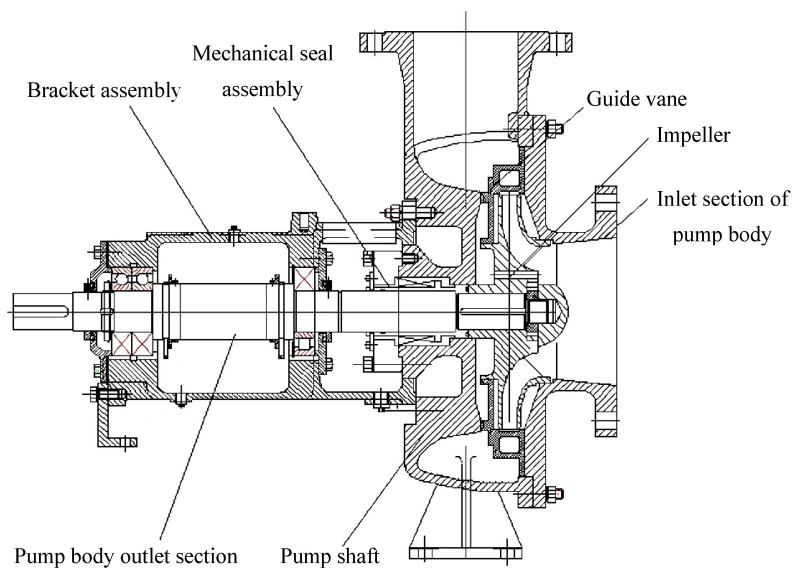
When selecting materials for mechanical seals, the first step is not to compare which material is harder, more wear-resistant, or more expensive, but rather to understand the fluid you need to seal and the actual operating conditions of the equipment.
You need to confirm what medium the pump is handling—for example, clean water, oils, acidic or alkaline solutions, solvents, or slurries containing particles.
Different media may react chemically with seal materials to varying degrees. Chemical compatibility refers to whether a material can maintain its normal physical and chemical properties when exposed to a specific medium without significant corrosion, swelling, or performance degradation.
Tip: Do not rely solely on the name of the medium to determine whether a material is suitable. You also need to understand the medium’s actual concentration, temperature, and any potential additives or impurities.
Next, you need to determine whether the fluid contains sand particles, crystals, metal powders, or other solid particles.
Abrasion refers to the gradual wear of a material’s surface caused by hard particles through friction and scratching. Sealing faces must fit well together; if particles enter the gap between the faces, they can cause scratches, wear, and leaks.
For clean water, consider pairing carbon graphite with a hard material. For slurries containing sand, evaluate more wear-resistant sealing face materials and seal designs.
Tip: Harder materials are not necessarily better; you must also consider particle size, concentration, hardness, and whether they are prone to accumulation. Simply replacing the face material may not resolve failures caused by particle buildup.
During operation, the mechanical seal faces rely on a very thin liquid film to aid in lubrication and dissipate frictional heat. This liquid film reduces direct contact between the faces, thereby lowering the risk of wear.
Tip: If the equipment is prone to dry running, fluid starvation, or frequent starts and stops, these risks should be identified in advance rather than assuming that simply replacing the wear-resistant materials will solve all problems.
In addition to particle wear, you also need to determine whether the fluid is prone to crystallization, scaling, polymerization, or solidification.
When dealing with media that are prone to crystallization or the formation of deposits, you must not only consider the material’s wear resistance but also assess the conditions under which deposits form. If necessary, appropriate sealing configurations or auxiliary measures should be implemented; simply replacing the face material with a harder one may not be effective.
Once the fluid properties have been determined, you will also need to collect the equipment’s actual operating parameters, including seal chamber pressure, temperature, shaft speed, and operating mode.
For pumps that operate continuously and chemical pumps that are frequently started and stopped, the choice of materials may differ even when they handle the same medium. Therefore, you should collect data on normal, maximum, and minimum operating conditions whenever possible, rather than relying solely on the rated parameters listed on the equipment nameplate.
The pressure, temperature, and rotational speed of a mechanical seal directly affect the forces acting on the sealing faces, the heat generated by friction, and the seal’s service life. Even when the same sealing materials are used, completely different wear and leakage patterns may occur under different operating conditions.
Operating pressure affects the stress conditions on the mechanical seal faces. The higher the pressure in the seal chamber, the greater the hydraulic pressure acting on the seal rings is likely to be. However, the actual face load depends on the seal design, the contact area, and the fluid film pressure on the faces; it cannot be determined solely based on the pump’s discharge pressure.
If the contact load on the faces is too high, it may increase friction, heat generation, and wear. If the forces acting on the faces are improperly distributed, it may also lead to deformation, face separation, or leakage.
Tip: For mechanical seals operating at high speeds, you need to focus on the materials’ wear resistance, friction characteristics, thermal conductivity, and whether the sealing faces are prone to deformation during operation.
Pressure, temperature, and rotational speed are not three completely independent factors; they collectively influence the operating conditions of a mechanical seal.
In mechanical seal design, the PV value is used to assist in evaluating the working load on the friction pair. P represents contact pressure, and V represents sliding speed. The PV value helps in understanding the combined effect of pressure and speed, but it cannot be used alone to determine whether a mechanical seal is safe.
You can use the table below to develop a preliminary approach to product selection.
| Operating Condition | Main Impact | Key Material Properties |
|---|---|---|
| High Pressure | Higher face load and possible deformation. | Strength, stiffness, dimensional stability. |
| High Temperature | Thermal deformation and material degradation. | Thermal stability and conductivity. |
| High Shaft Speed | Higher sliding speed, friction, and heat. | Wear resistance, friction performance, thermal conductivity. |
| High Pressure + High Speed | Higher friction load and overheating risk. | Strength, heat dissipation, and face stability. |
| Frequent Temperature Changes | Thermal expansion and stress. | Thermal shock resistance and expansion compatibility. |

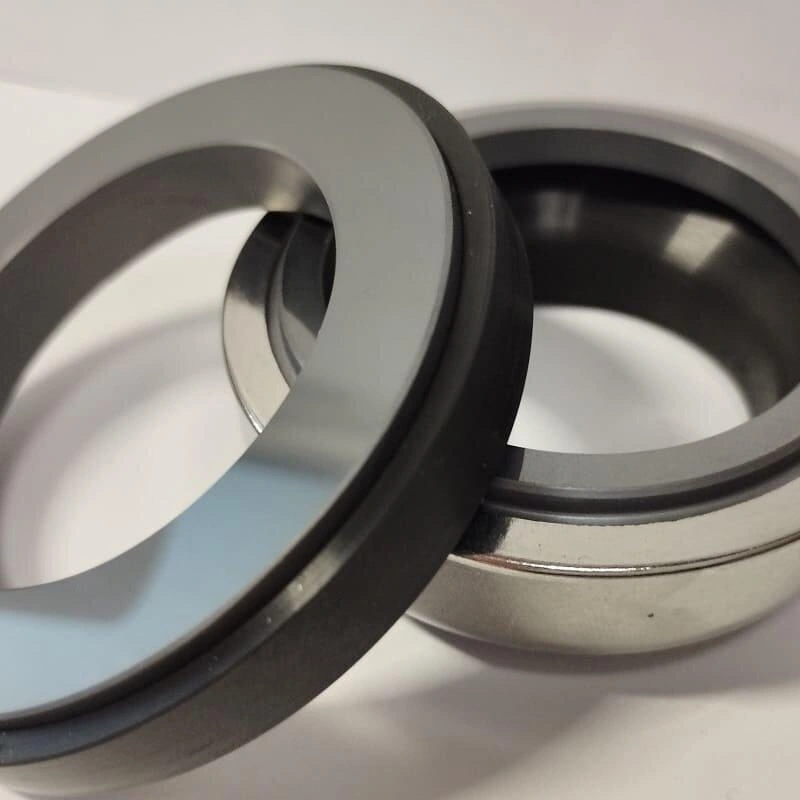
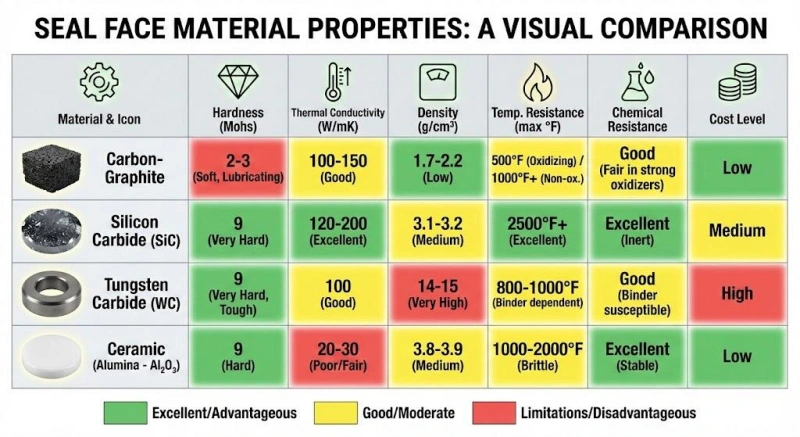
Common face materials used in mechanical seals include carbon graphite, ceramics, silicon carbide, and tungsten carbide. These materials differ significantly in terms of hardness, wear resistance, corrosion resistance, thermal conductivity, and mechanical strength.
| Comparison | Carbon Graphite | Ceramic | Silicon Carbide (SiC) | Tungsten Carbide (WC) |
|---|---|---|---|---|
| Main Features | Good friction behavior with some self-lubrication. | High hardness and relatively low cost. | High hardness, wear resistance, and thermal conductivity. | High hardness, wear resistance, and impact strength. |
| Hardness & Wear | Lower hardness; not ideal for severe abrasion. | High hardness; best for clean fluids. | Very high hardness and excellent wear resistance. | Very high hardness and excellent wear resistance. |
| Corrosion Resistance | Depends on carbon grade and impregnation. | Stable in many common fluids. | Generally good; depends on grade and process. | Strongly affected by the metal binder. |
| Thermal Conductivity | Depends on grade. | Lower than SiC. | Generally good. | Generally good. |
| Impact Resistance | Lower strength; avoid chipping. | Brittle and impact-sensitive. | Brittle; avoid impact and edge chipping. | Generally better fracture toughness. |
| Common Types | Resin- or metal-impregnated carbon. | Various alumina grades. | RB-SiC, SSiC. | WC-Co, WC-Ni. |
| Typical Applications | Clean water, oils, well-lubricated fluids. | Clean water and mild pump service. | Chemicals, wastewater, abrasive fluids. | Slurries, heavy-duty, impact-prone service. |
| Avoid When | Severe abrasion or many hard particles. | Severe thermal shock or abrasion. | High impact or incompatible chemical service. | Binder is incompatible with the fluid. |
| Main Advantage | Good friction performance with hard-face pairings. | Economical for mild service. | Strong wear, corrosion, and heat-transfer performance. | Combines wear resistance with mechanical toughness. |
| Main Limitation | Sensitive to hard-particle wear. | Brittleness and thermal-shock sensitivity. | Brittleness and grade-dependent performance. | Binder may corrode. |
| Selection Guide | Best for clean fluids with good lubrication. | Best for cost-sensitive, mild water service. | Best for higher wear, corrosion, and heat-transfer needs. | Best where both wear resistance and impact strength matter. |
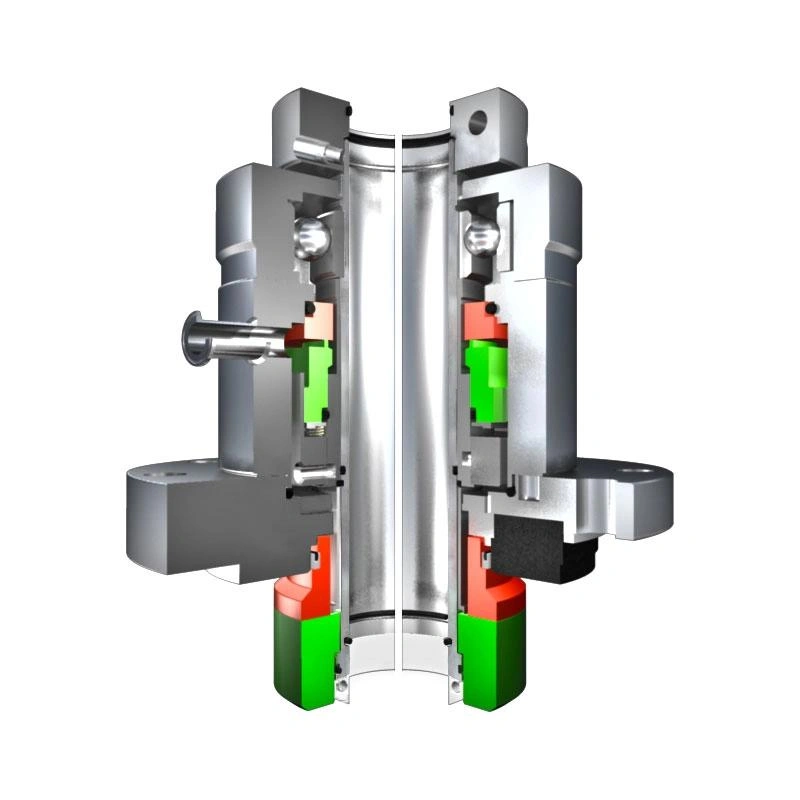
A mechanical seal consists of a rotating face and a stationary face. The two faces must fit together properly to effectively control fluid leakage.
Common face pairings are classified as soft-on-hard and hard-on-hard.
Soft-hard pairing refers to the use of a relatively soft face material in combination with a hard material.
The main advantage of this pairing is that carbon graphite offers good friction properties and a certain degree of self-lubrication. When the lubricating film between the two faces is thin, carbon graphite helps reduce the friction and wear caused by direct contact.
Hard-hard pairing refers to the use of hard materials for both sealing faces. Common combinations include silicon carbide with silicon carbide and tungsten carbide with tungsten carbide.
The main advantage of this pairing is that both faces possess high hardness and wear resistance. When sand, mineral particles, or other abrasive impurities are present in the fluid, hard materials are generally better able to resist scratching and wear caused by these particles than carbon graphite.
| Comparison | Soft-Hard Pairing | Hard-Hard Pairing |
|---|---|---|
| Common Pairings | Carbon/SiC, Carbon/Ceramic | SiC/SiC, WC/WC |
| Main Advantage | Good friction performance for clean fluids. | Better wear resistance for some particle-laden fluids. |
| Friction Behavior | Carbon helps reduce boundary friction. | Depends more on proper lubrication and face design. |
| Particle Wear Resistance | Soft faces are more vulnerable to hard particles. | Generally more resistant to abrasive wear. |
| Poor Lubrication | Suitable carbon pairings offer some tolerance. | May generate higher friction and heat. |
| Typical Applications | Clean water, oils, general industrial pumps. | Slurry pumps, wastewater pumps, abrasive fluids. |
| Main Limitation | Soft faces may wear faster. | Higher thermal-damage risk under poor lubrication. |
| Selection Focus | Friction performance and fluid cleanliness. | Wear resistance, lubrication, and heat dissipation. |
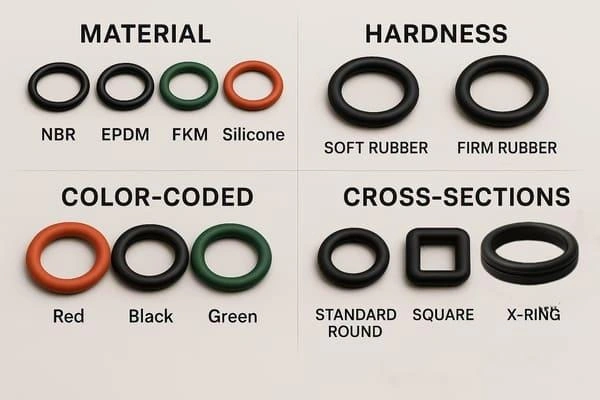
Elastomers are a class of materials with good elastic recovery properties. They are commonly used to manufacture O-rings and other auxiliary seals, which help prevent fluid from leaking through the gaps between the sealing ring and other components.
Chemical compatibility refers to whether an elastomer can maintain the necessary physical and sealing properties after coming into contact with a specific medium.
If the material is incompatible with the medium, swelling may occur—that is, the rubber absorbs the medium and increases in volume. In severe cases, the O-ring may become compressed or deformed, potentially even affecting the normal movement of the sealing ring.
EPDM offers excellent resistance to hot water, steam, and aging, as well as good resistance to certain acidic and alkaline solutions and polar media.
If your equipment transports hot water or comes into contact with steam, EPDM is a material worth prioritizing. For example, EPDM auxiliary seals can be used in certain hot water circulation pumps and cleaning systems designed with appropriate materials.
NBR is a common industrial sealing material. Its main advantages include good resistance to many mineral oils, lubricants, and petroleum-based fluids, as well as a generally low cost.
For equipment that handles standard lubricants, hydraulic fluids, or other compatible oil-based media, NBR is typically an economical and practical choice.
FKM offers good heat resistance and can withstand many oils, fuels, and chemical media. Viton is a common commercial brand name in the fluorocarbon rubber sector, but not all FKM compounds should be considered identical.
Compared to NBR, suitable FKM materials can withstand higher operating temperatures. For oil transfer equipment operating at high temperatures, FKM is a viable option for secondary sealing materials.
Tip: However, FKM is not a universal chemical-resistant rubber. Standard FKM may not provide sufficient resistance to certain ketones, amines, or high-temperature hot water or steam.
FFKM is a class of high-performance elastomers with excellent chemical resistance and high-temperature resistance.
Compared to NBR, EPDM, and FKM, FFKM is compatible with a wider range of chemical media and is therefore commonly used in chemical processing equipment and other specialized industrial applications where material compatibility is critical.
The table below can help you narrow down your options based on media type and operating requirements.
| Material | Main Advantages | Typical Fluids | Main Limitations |
|---|---|---|---|
| EPDM | Good resistance to hot water, steam, and some polar fluids. | Hot water, suitable steam service, some acids and alkalis. | Generally unsuitable for mineral oils and petroleum fuels. |
| NBR | Good oil resistance and relatively low cost. | Mineral oil, lubricating oil, some hydraulic fluids. | Limited high-temperature resistance and chemical compatibility. |
| FKM | Good heat resistance and compatibility with many oils and fuels. | Hot oils, fuels, and some chemical fluids. | Standard grades may be unsuitable for steam, amines, and ketones. |
| FFKM | Broad chemical resistance and high-temperature capability in some grades. | Aggressive chemicals and some high-temperature services. | High cost; performance must be verified by grade. |
You need to verify not only the normal fluid temperature, but also the maximum and minimum temperatures that may occur during startup, shutdown, and brief periods of abnormal operation.
You also need to pay attention to compression set. This refers to the phenomenon where an elastomer fails to fully recover its original thickness after prolonged compression.
In addition to the sealing faces and rubber seals, mechanical seals also consist of springs, shaft sleeves, gland nuts, fasteners, and other metal components. These parts must not only withstand mechanical loads but may also be exposed to water, oils, or corrosive chemical media over extended periods.
Corrosion resistance refers to a metal’s ability to withstand chemical or electrochemical corrosion when exposed to specific liquids or gases.
Common metal materials used in mechanical seals include 304 stainless steel, 316 stainless steel, duplex stainless steel, and certain nickel-based alloys.
Mechanical strength refers to a material’s ability to withstand pressure, tensile force, or other mechanical loads without undergoing excessive deformation or failure.
If a material lacks sufficient strength, or if a part is poorly designed, it may deform under high pressure, vibration, or thermal expansion, thereby affecting the proper fit of the sealing surfaces.
For equipment operating at high pressures or under heavy mechanical loads, you need to pay attention to the material’s yield strength. This refers to the stress level at which a material begins to exhibit noticeable permanent deformation.
Springs are a critical component of mechanical seals. One of their primary functions is to provide the necessary spring force to help the sealing faces maintain proper contact during operation.
If a spring corrodes, breaks, or loses its necessary elasticity, it can cause abnormal loads on the sealing faces, thereby increasing the risk of leakage.
When selecting spring materials, in addition to corrosion resistance, you should also consider fatigue performance and stress relaxation.
During actual operation, mechanical seals may be subject to issues such as wear caused by solid particles, dry running, and insufficient lubrication. These factors can disrupt the normal operating conditions of the sealing faces, and even when high-hardness materials are used, they may lead to leakage or premature failure.
Abrasion refers to the process by which hard particles gradually wear down a material’s surface through friction or scratching. During the operation of a mechanical seal, a very thin liquid film typically exists between the two sealing faces.
For media containing significantly abrasive particles, you may want to prioritize hard sealing face materials such as silicon carbide or tungsten carbide. These materials offer good resistance to abrasive wear.
Tip: In some slurry pumps, hard-on-hard face pairings such as SiC/SiC or WC/WC are also used to reduce wear caused by hard particles. However, for tungsten carbide, the chemical compatibility of the metal binder with the medium must also be verified.
Solid particles do not necessarily cause only wear; they can also accumulate inside mechanical seals.
Mechanical seals rely on spring force and the slight axial displacement of the sealing rings to compensate for face wear and dimensional changes during equipment operation. If solid particles cause components to jam, leakage may occur even if the face materials have not suffered significant wear.
Tip: External flushing is not suitable for all processes. If the cleaning flush solution would contaminate the product or affect process concentrations, an alternative, proven sealing solution must be selected.
Dry running refers to the operation of mechanical seal faces without the necessary lubricating fluid. For mechanical seals lubricated by ordinary liquids, this is a hazardous operating condition that must be strictly avoided.
During normal operation, the liquid film between the two seal faces helps reduce friction and dissipate some of the heat. If the liquid film disappears, the faces may come into direct contact, causing a rapid increase in frictional heat.
Inadequate lubrication is not the same as completely dry running. Inadequate lubrication means that there is still fluid between the sealing faces, but the fluid film is insufficient or unstable and cannot continuously provide normal lubrication.
Causes of inadequate lubrication include low fluid viscosity, excessive temperature in the sealing area, localized pressure drops, and vaporization of the fluid near the sealing faces.
Different operational issues affect different parts of a mechanical seal, so different diagnostic methods are required.
| Operating Issue | Main Risk | Preferred Material / Action |
|---|---|---|
| Hard Particle Abrasion | Face scratching and accelerated wear. | Use wear-resistant materials such as SiC or WC; consider hard-hard pairing. |
| Solids Buildup | Spring or seal ring sticking. | Use anti-clogging seal designs and particle-control measures. |
| Crystallizing Fluids | Crystal deposits and face damage. | Use suitable seal designs and support measures for crystallizing service. |
| Dry Running | Friction heat, thermal cracking, and face damage. | Prevent loss of liquid; use dry-running seals if required. |
| Poor Lubrication | Unstable fluid film, friction, and wear. | Improve lubrication and cooling; select suitable face pairing. |
| Abrasion + Poor Lubrication | Higher risk of wear, overheating, and failure. | Evaluate materials, seal design, and support systems together. |
Even if a sealing material has good wear resistance and corrosion resistance, it may still be unsuitable for these industries if it is prone to product residue buildup, microbial growth, or cannot withstand repeated cleaning and sterilization.
You need to consider the material’s chemical resistance, temperature resistance, hygienic design, and regulatory requirements all at the same time.
CIP refers to the process of cleaning the internal surfaces of equipment that come into contact with the product by circulating a cleaning solution, without the need to completely disassemble the equipment.
CIP is frequently used in food and pharmaceutical equipment to remove product residues, oils, and other contaminants.
For mechanical seals, this means that the materials must not only withstand the products being transported under normal operating conditions but also be compatible with the chemical properties and temperature of the cleaning solution.
SIP refers to the sterilization of the interior of equipment without completely disassembling it. While the term “Steam-in-Place” is sometimes used to denote in-place steam sterilization, the actual SIP process should be determined in accordance with equipment and process documentation.
Compared to standard production processes, sealing materials may need to withstand higher temperatures, rapid temperature changes, and repeated heating and cooling cycles.
For food and pharmaceutical equipment, simply selecting corrosion-resistant materials is not enough. The design of mechanical seals must also facilitate cleaning and minimize the accumulation of product residues and microorganisms.
Hygienic design refers to the use of appropriate equipment design, materials, and surface treatments to reduce the risk of contamination and improve cleaning effectiveness.
Food and pharmaceutical equipment may use similar mechanical seal materials, but their hygiene requirements and validation methods are not entirely the same.
For food processing equipment, you need to focus on whether the materials are suitable for food contact, whether they are easy to clean, and whether they might release prohibited substances into the product.
For pharmaceutical equipment, in addition to corrosion resistance and cleanability, you may also need to consider material traceability, the risk of product contamination, and the validation of cleaning and sterilization processes.
Different markets and industries may have different regulations, standards, or engineering guidelines. You need to determine which requirements apply based on the region where the product is sold and its intended use.
| Regulation / Standard | Main Focus | What to Check for Mechanical Seals |
|---|---|---|
| FDA / 21 CFR | Food-contact material composition and use conditions. | Verify elastomers and other wetted materials meet applicable requirements. |
| EC 1935/2004 | Safety and migration risks of food-contact materials. | Confirm food-contact materials meet applicable requirements. |
| EC 2023/2006 | Good manufacturing practices for food-contact materials. | Confirm the supplier follows applicable GMP requirements. |
| EHEDG GL 25 | Cleanability, sterilization, hygienic design, and materials. | Verify the seal design meets project hygiene requirements. |
| ASME BPE | Materials, design, fabrication, inspection, and quality requirements. | Confirm bioprocess equipment meets specified project requirements. |
You can perform an initial screening based on production media, cleaning methods, sterilization conditions, and regulatory requirements.
| Application Condition | Preferred Material / Design | Key Selection Basis |
|---|---|---|
| General Food Fluids | 316L, suitable seal faces, and food-contact elastomers. | Food-contact safety and corrosion resistance. |
| Regular CIP | Metals, seal faces, and elastomers resistant to cleaning chemicals. | Cleaner compatibility and cleanability. |
| Steam SIP | Thermal-shock-resistant faces and steam-compatible elastomers. | Steam conditions and thermal-cycle stability. |
| High-Hygiene Food Production | Hygienic mechanical seal design. | Dead-space control, cleanability, and contamination risk. |
| Aseptic Pharma / Bioprocessing | Validated hygienic or aseptic seal systems. | Material traceability, cleaning/sterilization validation, and applicable standards. |
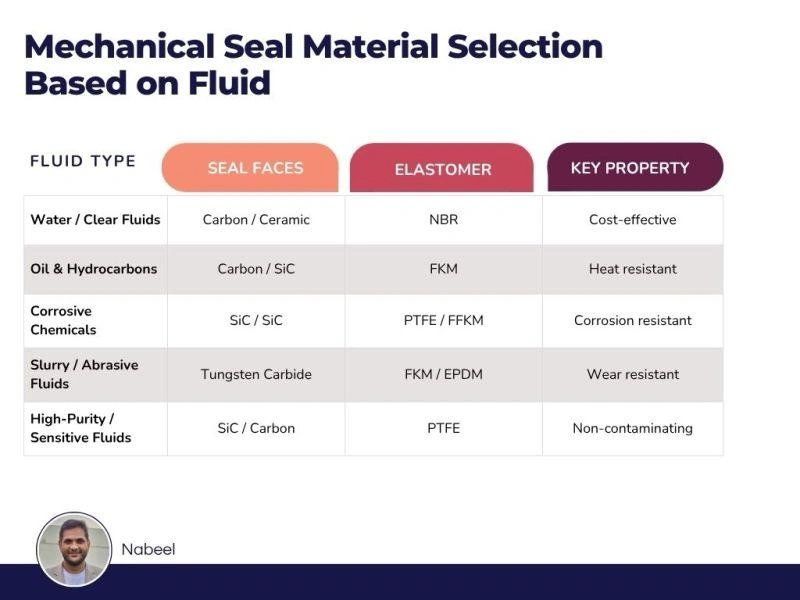
A material selection matrix is a tool that organizes operating conditions, material properties, and associated risks into a table. It helps you compare different material combinations, narrow down candidate options, and identify issues that require further validation.
Please note that a material selection matrix is intended only for preliminary screening and cannot replace chemical compatibility testing or technical validation by the manufacturer.
1. Confirm the fluid’s name, chemical composition, and concentration.
2. Record the operating pressure, normal temperature, maximum and minimum temperatures, and shaft speed of the seal chamber. Do not rely solely on the rated parameters listed on the pump nameplate, as actual conditions within the seal chamber may differ.
3. You should also check whether the fluid contains solid particles, is prone to crystallization, and whether there is a risk of insufficient lubrication or dry running.
You can match common operating conditions with material requirements to create a preliminary selection matrix.
| Operating Condition | Face Material / Pairing | Elastomer Options | Metal Material |
|---|---|---|---|
| Clean Water / Mild Service | Carbon/Ceramic, Carbon/SiC | Compatible EPDM or NBR grades | 316 Stainless Steel |
| Mineral Oil | Carbon/SiC | NBR, suitable FKM grades | 316 Stainless Steel |
| Corrosive Chemicals | Compatible SiC or other suitable pairings | EPDM, FKM, or FFKM as compatible | Corrosion-resistant alloys |
| Sandy / Abrasive Slurry | SiC/SiC, WC/WC | Selected by fluid compatibility | Consider corrosion, wear, and strength |
| High-Temperature / Volatile Fluids | Select based on lubrication and heat removal. | Verify actual temperature capability in the fluid. | Check high-temperature strength and corrosion resistance. |
| CIP / SIP Hygienic Service | Validated hygienic face pairing | Cleaning- and steam-resistant grades | 316L or other suitable hygienic materials |
Chemical compatibility means a material keeps its physical properties and chemical stability in a specific medium.
Mechanical seals use multiple materials, and each component may react differently.
For seal faces, check the base material, carbon-graphite impregnants, and tungsten carbide binders.
For elastomers like O-rings, watch for swelling, hardening, softening, or loss of elasticity. Some rubbers hold up at room temperature but swell at higher temperatures.
For metal parts, check for pitting, crevice corrosion, and stress corrosion cracking. Even small parts like springs, bushings, and fasteners can affect the whole seal if they corrode.
A material compatibility chart is a table compiled by manufacturers that outlines the compatibility of materials with chemical media based on material properties, test results, or engineering data.
These charts classify materials into categories such as “recommended,” “conditionally acceptable,” “not recommended,” or “insufficient data.” However, rating systems may vary among manufacturers, so you should first familiarize yourself with the specific rating criteria.
Even if all materials have good chemical compatibility, there is no guarantee that the entire mechanical seal assembly will function properly.
This is because the reliability of a mechanical seal also depends on face load, lubrication, heat dissipation, shaft speed, and structural design.
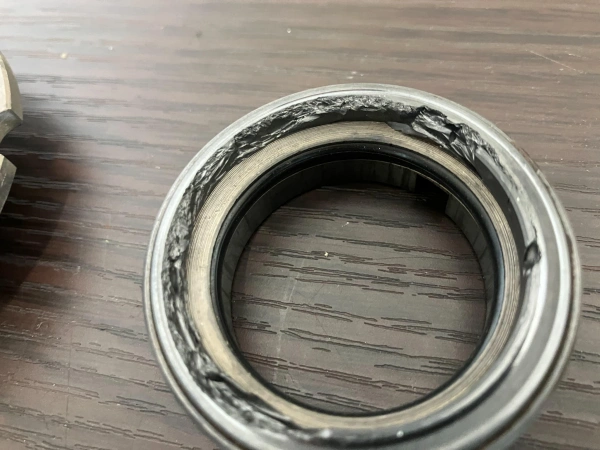
Incorrect selection of mechanical seal materials is one of the major causes of seal leakage, abnormal wear, and premature failure.
| Common Mistake | Risk | Correct Approach |
|---|---|---|
| 1. Choosing Based Only on Hardness | Harder faces may still wear or overheat if friction, lubrication, and cooling are poor. | Use soft-hard pairs for clean fluids; consider hard-hard pairs for abrasive service. |
| 2. Ignoring Chemical Compatibility | WC binders and some SiC grades may corrode in certain fluids. | Check fluid composition, concentration, temperature, and material grade. |
| 3. Selecting Elastomers Only by Temperature | High temperature ratings do not guarantee chemical compatibility. | Check fluid compatibility first, then temperature limits. |
| 4. Overlooking Metal Components | Springs, sleeves, and fasteners may corrode even when faces and O-rings are suitable. | Verify all wetted metal parts for corrosion and fatigue resistance. |
| 5. Assuming Hard Faces Can Run Dry | Poor lubrication can cause overheating and face damage. | Maintain proper lubrication or use a validated dry-running seal. |
| 6. Reusing Old Materials After Process Changes | Changes in fluid, pressure, temperature, or cleaning agents may make old materials unsuitable. | Recheck materials whenever operating conditions change. |
| 7. Treating Material Upgrades as a Universal Fix | Leakage may come from vibration, misalignment, installation, or lubrication problems. | Find the root cause before changing materials. |
Carbon/graphite and silicon carbide (Carbon/SiC) are widely used seal face combinations that balance friction characteristics, wear resistance, and thermal conductivity, making them suitable for many clean liquid applications. However, no single material is suitable for all media; the final selection must still be based on temperature, pressure, and lubrication conditions.
Silicon carbide should be prioritized when the operating conditions place greater emphasis on corrosion resistance, thermal conductivity, and wear resistance. Tungsten carbide cemented carbide typically offers better resistance to mechanical shock, but its metal binder may be susceptible to corrosion. The specific choice should be based on the material grade and the properties of the medium.
soft-hard pairing refers to a combination of carbon graphite with hard materials such as ceramics or silicon carbide (SiC). It is typically suitable for clean, well-lubricated liquids. A hard-hard pairing refers to combinations such as SiC/SiC or WC/WC. These pairings generally offer better resistance to abrasive wear and are suitable for certain media containing particles, though they still require adequate lubrication and heat dissipation.
Properly formulated EPDM (ethylene propylene diene monomer) is typically the preferred material for hot water and steam applications. However, the temperature and steam resistance vary among different EPDM grades and must be verified based on the actual temperature, pressure, and contact time.
No. Different chemical media may cause corrosion, swelling, or other damage to the sealing faces, elastomers, and metal components. Even materials with good chemical resistance, such as silicon carbide or FFKM, are not suitable for all media; specific material grades and chemical compatibility must be verified.
Dry running deprives the sealing faces of necessary lubrication and cooling, increasing the risk of frictional heat, wear, and cracking. Although carbon graphite possesses some self-lubricating properties, standard mechanical seals cannot operate dry for extended periods. If dry running cannot be avoided, a seal specifically designed and validated for dry operation should be selected.
Not necessarily, but for media containing a high concentration of hard particles, hard-on-hard combinations such as SiC/SiC or WC/WC are generally worth evaluating first. Ultimately, particle size, concentration, lubrication conditions, and seal design must also be considered. Using hard materials alone does not solve all abrasion problems.
Incompatible materials may undergo corrosion, swelling, hardening, abnormal wear, or cracking, leading to improper seal face contact, leakage, or even premature failure. Therefore, during the selection process, it is essential to verify the compatibility of the seal face materials, elastomers, and metal components with the actual medium and operating conditions.
Selecting the right mechanical seal materials is a critical step in reducing leakage, improving reliability, and extending equipment life. Carbon-graphite, ceramics, silicon carbide, and tungsten carbide each have their own advantages, but no single material is suitable for all operating conditions. The choice of face materials and mating configurations must be determined based on the medium, pressure, temperature, rotational speed, and lubrication conditions.
If you are unsure which material combination is most suitable, contact Sakowitz and provide key operating conditions—such as the type of medium, temperature, pressure, and rotational speed—so they can further evaluate the appropriate materials and configurations.
—— We Will Provide You With Professional OEM Solutions.
Whether you require pump bearings, pump valves, mechanical seals, or other custom-engineered components, we support production based on your drawings as well as rapid prototyping.
Please complete the form on the right and upload your technical drawings or specifications. Our engineering team will review your requirements within 24 hours and provide a detailed quotation, application recommendations, and delivery schedule.
Copyright © 2025 Sakowit, All rights reserved.
WhatsApp us