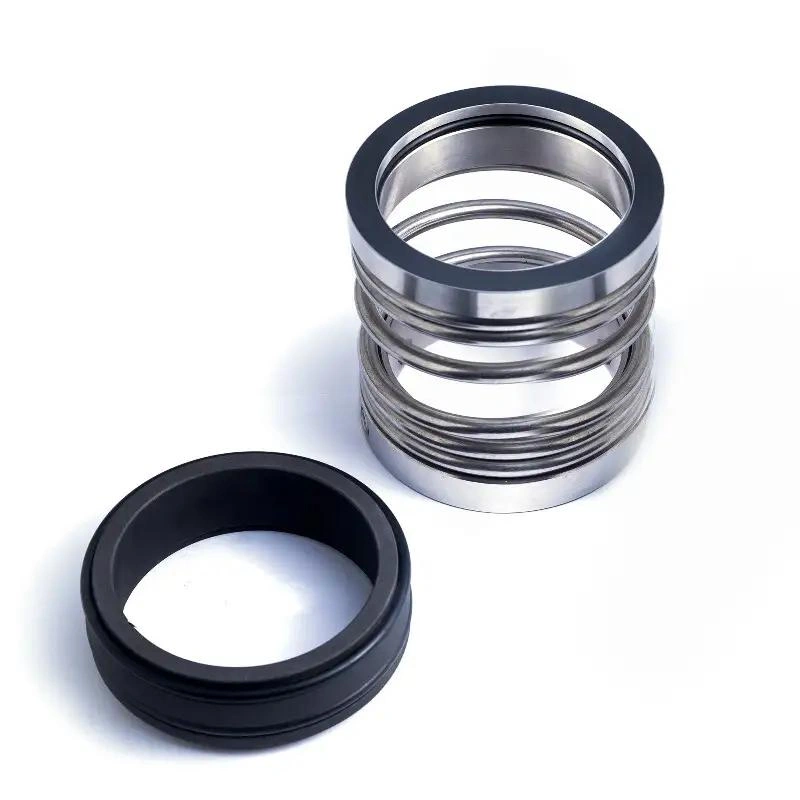

When maintaining pumps or industrial equipment, one common question is: should you choose gland packing or a mechanical seal?Both are widely used pump sealing methods, but they control leakage in different ways and suit different operating conditions.Gland packing seals around the rotating shaft by compressing packing material with a gland. Its structure is simple, practical, and relatively easy to maintain.
It is often suitable for less demanding applications where a small amount of controlled leakage is acceptable.A mechanical seal uses two closely fitted sealing faces to control fluid leakage around the shaft.It usually provides lower leakage, stable operation, and longer maintenance intervals than gland packing.
However, mechanical seals are more complex and usually cost more. They also require proper installation and suitable operating conditions.Choosing the wrong sealing method can cause excessive leakage, shaft wear, overheating, frequent maintenance, or unexpected equipment downtime.In this guide, you will learn the differences between gland packing and mechanical seals, their advantages, common problems, and how to choose the right seal.
If you are new to pump sealing, gland packing and mechanical seals can be confusing at first.Gland packing is a traditional shaft sealing method. It is widely used in pumps, valves, mixers, and other rotating equipment.It works by tightening the packing gland so the packing presses against the shaft and reduces fluid leakage along the shaft.Gland packing usually allows a small amount of controlled leakage.
Its main advantages are simple construction, lower initial cost, and easy adjustment or replacement.However, if the packing is tightened too much, it can increase friction, heat, and energy use.It can also speed up wear on the shaft or shaft sleeve.A mechanical seal mainly controls leakage through two smooth sealing faces.During operation, these two faces stay very close to each other.A very thin fluid film usually forms between the sealing faces.
This film helps reduce friction, remove heat, and control fluid leakage.Compared with gland packing, a mechanical seal usually keeps visible leakage much lower.It is often used where cleaner operation, lower fluid loss, or less frequent maintenance is required.However, mechanical seals are more sensitive to installation quality and operating conditions.Dry running, dirty fluids, excessive vibration, or unsuitable operating conditions can shorten the seal’s service life.
When inspecting pumps, fans, and other rotating equipment, pay attention to the shaft seal between the shaft and the housing.The main role of a shaft seal is to reduce liquid or gas leakage along the rotating shaft.In pumps, without a reliable shaft seal, the pumped fluid may continuously leak through the gap between the shaft and pump casing.
But a shaft seal does more than just stop leakage.It must also balance sealing performance with smooth shaft rotation.If the seal is too tight, leakage may decrease, but friction, heat, and shaft wear can increase.In some equipment, shaft seals also help keep air, dust, and other outside contaminants from entering the machine.For example, when the pump inlet is under negative pressure, a poor seal may allow air to enter and affect normal pump operation.
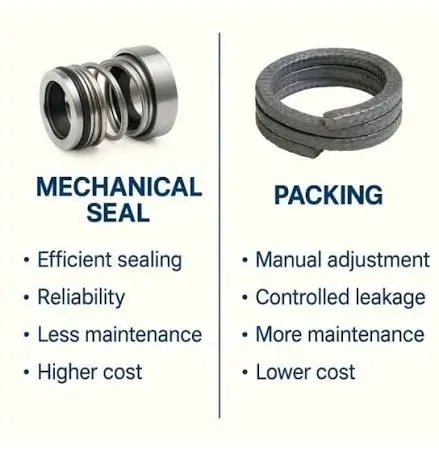
If you only want the basic difference, remember this: gland packing controls leakage by compression, while a mechanical seal uses two sealing faces.Gland packing has a simple structure, lower cost, and is easy to adjust or replace.It usually allows a small amount of controlled leakage, so it suits applications where very low leakage is not required.Mechanical seals usually provide lower leakage and less friction.
They are better suited to equipment where cleanliness, safety, and reduced fluid loss are important.However, mechanical seals are more complex and usually have a higher initial cost.They are also more sensitive to installation quality, fluid condition, and operating conditions.Simply put, choose gland packing if you value simple design, lower cost, and easy maintenance.
Choose a mechanical seal if you need lower leakage, less frequent maintenance, and more stable sealing performance.However, price should not be the only factor.You should also consider the fluid, pressure, temperature, shaft speed, allowable leakage, and maintenance conditions.
You may wonder how gland packing actually stops fluid from leaking. The working principle is quite simple.When the packing is compressed, it creates contact pressure against the shaft or shaft sleeve and reduces leakage along the shaft.Several packing rings are usually installed inside the stuffing box and wrapped around the shaft.After installation, the packing gland is tightened to apply axial pressure to the packing rings.
As the packing is compressed, it expands outward and inward.It presses against the shaft on the inside and against the stuffing box wall on the outside.This forces the fluid to pass through the compressed packing area instead of leaking freely through the shaft gap.As a result, the amount of leakage is greatly reduced.However, gland packing usually does not provide completely zero leakage.
Many pump packing systems need a small amount of controlled leakage to help lubricate and cool the contact area.If the gland is too loose, leakage can become too high and sealing performance will be poor.If the gland is too tight, leakage may decrease for a short time, but friction and temperature will increase.This can also speed up wear on the packing, shaft, or shaft sleeve.So remember, the goal is not to tighten the packing as much as possible.The key is to balance leakage, lubrication, cooling, and friction.
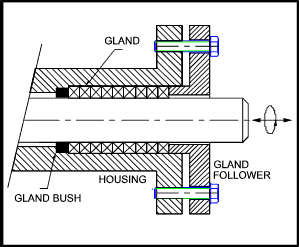
To understand gland packing, you first need to know three basic parts: packing rings, the stuffing box, and the gland follower.Together, these parts help compress the packing correctly and keep the sealing system working properly.
Packing rings are sealing materials installed directly around the rotating shaft.The packing is usually cut into several rings and installed one by one inside the stuffing box.When compressed, the packing rings press against the shaft or shaft sleeve and reduce fluid leakage along the shaft.Packing materials are selected based on the fluid, temperature, pressure, and shaft speed.Common materials include graphite, PTFE, and different types of braided fibers.
The stuffing box is the space that holds the packing rings, usually located between the equipment housing and the rotating shaft.You can think of it as a chamber designed specifically to hold the packing.The packing rings are placed inside this chamber and arranged around the shaft.The stuffing box keeps the packing in position and provides support when the packing is compressed.If its size, surface condition, or alignment is poor, the packing may be compressed unevenly.This can lead to leakage, overheating, or uneven wear.
The gland follower is located outside the packing rings and applies pressure to the packing.When you tighten the gland bolts, the gland follower pushes the packing rings in the axial direction.This pressure deforms the packing, pressing it inward against the shaft and outward against the stuffing box wall.However, the gland follower should not be tightened too much at once.Too much pressure increases friction and temperature and can speed up wear on the packing and shaft sleeve.
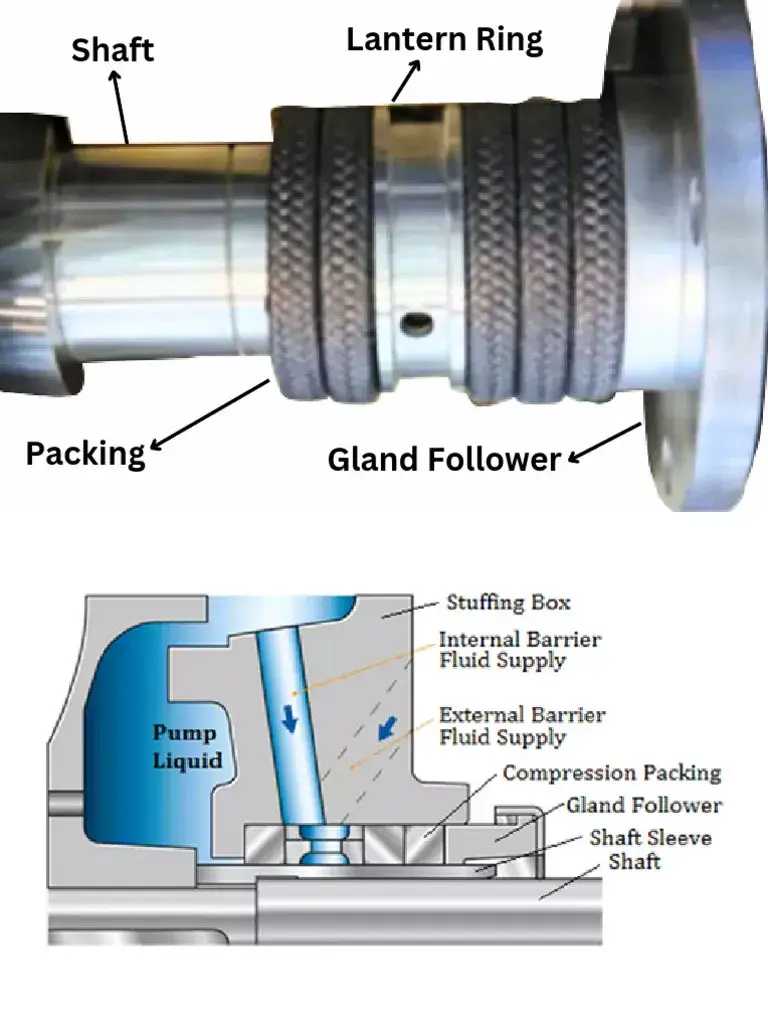
When you first start servicing pumps, you may wonder: if gland packing already leaks, why must the leakage still be controlled?The packing stays in constant contact with the shaft or shaft sleeve.As the shaft rotates, this contact creates friction and heat.A small amount of fluid passing through the packing helps lubricate the contact area.It also carries away some of the heat caused by friction.
If you tighten the packing too much to stop all leakage, lubrication between the packing and shaft may become insufficient.This can increase friction and temperature, harden or damage the packing, and speed up shaft sleeve wear.On the other hand, too much leakage may mean the packing is too loose, worn, or installed incorrectly.
So gland packing needs controlled leakage, not simply the lowest possible leakage.The correct leakage rate depends on the packing material, shaft size, speed, fluid, pressure, and equipment manufacturer’s requirements.Do not simply follow one fixed leakage standard.Different packing materials and equipment may need different levels of lubrication and cooling.
You should know that gland packing is available in different materials.Common options include graphite, PTFE, and aramid.Each material has different properties and suits different operating conditions.
Graphite packing has good heat resistance and thermal conductivity, while also providing relatively low friction.It is widely used in pumps, valves, and equipment operating at higher temperatures.Graphite can help carry away heat created by friction.This makes it suitable for many applications involving higher temperatures and moderate pressure.It also has good chemical resistance and can work with many fluids.However, you should still check the fluid type and the packing manufacturer’s data before using it.
PTFE packing offers strong chemical resistance and low friction.It is often used in chemical pumps handling acids, alkalis, and other corrosive fluids.PTFE is relatively soft and usually causes less wear on the shaft or shaft sleeve.This makes it suitable for many clean-fluid applications.
However, PTFE usually transfers heat less effectively than graphite.In high-temperature conditions or areas with poor cooling, you should pay close attention to packing temperature.When choosing PTFE packing, do not consider chemical resistance alone.You should also check temperature, pressure, and shaft speed limits.
Aramid packing is made from high-strength aramid fibers.Its main advantages are high mechanical strength and good wear resistance.It is often better suited to fluids containing solid particles, slurries, or other abrasive materials.For example, aramid packing can be used in some slurry pumps, wastewater pumps, and other equipment handling abrasive fluids.
Its strong fibers can help the packing resist wear.However, aramid is relatively hard.If the packing is too tight or the shaft sleeve surface is poor, it may increase shaft or sleeve wear.When using aramid packing, pay close attention to gland adjustment, shaft sleeve hardness, and operating temperature.
Do you know how a mechanical seal works?Simply put, a mechanical seal mainly consists of four parts: a rotating face, a stationary face, a spring, and secondary seals.The stationary face is fixed to the pump housing and does not rotate.The rotating face turns together with the pump shaft at high speed.The spring provides steady pressure, keeping the two very flat sealing faces closely pressed together.
You may think the two faces simply press tightly together to stop leakage, but that is not the whole story.A very thin liquid film exists between the smooth sealing faces.This invisible, micron-thin film is one of the most important parts of mechanical seal operation.It lubricates the sealing faces and helps prevent damage caused by high-speed dry friction.At the same time, it helps control fluid leakage to a very low level.
During operation, the spring keeps applying pressure to the sealing faces.Even if the faces wear slightly, the spring helps them stay in contact and maintain the seal.The secondary seals block leakage through gaps around the sealing faces.This helps prevent fluid from escaping through other possible leakage paths.
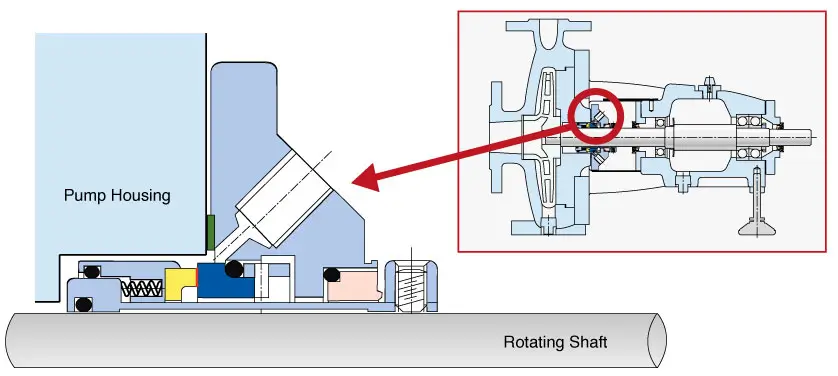
To understand a mechanical seal, you first need to know three key parts: the rotating face, stationary face, and secondary seals.
The rotating face is mounted on the shaft and rotates together with the pump shaft.Its sealing surface stays very close to the stationary face during operation.The rotating face needs good flatness and wear resistance because it keeps rotating at high speed.Common face materials include carbon graphite, silicon carbide, and tungsten carbide.The right material depends on the fluid, pressure, temperature, and shaft speed.
The stationary face is usually fixed inside the pump housing, seal gland, or seal seat.It does not rotate with the shaft.Together with the rotating face, it forms the main sealing surface of the mechanical seal.Both sealing faces need to stay flat, clean, and properly aligned.Scratches, dirt, or poor alignment can damage the thin liquid film and increase leakage and wear.
Secondary seals stop fluid from leaking through areas outside the main sealing faces.Common secondary seals include O-rings, gaskets, bellows, and other flexible sealing parts.These parts do not provide the main face seal, but they are still important for reliable sealing.If they become old, cracked, swollen, or incompatible with the fluid, leakage may occur even when the main faces are still in good condition.
When studying mechanical seals, you may wonder how the rotating and stationary faces can stay close together while running at high speed.The answer is the thin fluid film between them.This film is important for both leakage control and heat removal.As the rotating face turns with the shaft, the spring keeps the two sealing faces pressed together.At the same time, fluid enters the tiny gap between the faces under pressure.
This creates a very thin fluid film, usually only a few microns thick.The film must stay within the right range.If it becomes too thick, more fluid may pass through the sealing faces and leakage can increase.If it becomes too thin, lubrication becomes poor and the faces may begin to run dry.Dry contact creates a large amount of heat and can quickly damage the sealing faces.The fluid film also provides lubrication and carries away heat created by friction between the two faces.
This helps prevent excessive temperature and damage to the sealing surfaces.At the same time, the film limits how easily fluid can pass through the very narrow gap.This keeps leakage at a very low level.In simple terms, the fluid film creates a balance between lubrication, cooling, and leakage control.The film can also adjust as operating conditions change.
When fluid pressure changes, the film thickness may also change.If the sealing faces wear slightly, the spring continues to apply pressure and helps keep the faces in the correct position.This helps the fluid film remain stable and keeps the seal working properly.
Mechanical seals come in many types.If you are new to them, first understand two common comparisons: component vs cartridge seals, and single vs double seals.
A component mechanical seal is the traditional design with separate parts.The rotating face, stationary face, spring, and secondary seals are installed separately.During installation, each part must be assembled in order, and the spring compression must be adjusted correctly.One advantage is that individual parts can be replaced, which can reduce repair costs.However, installation requires more care.If the spring compression is incorrect, the seal may overheat and fail earlier than expected.
A cartridge mechanical seal is pre-assembled at the factory.Its main parts and spring compression are already set before installation.At the site, you usually install the complete seal assembly directly onto the shaft.This makes installation easier, reduces mistakes, and allows faster replacement during maintenance.The main disadvantage is the higher purchase price.When damaged, the complete cartridge is often replaced.It is well suited to production lines where fast maintenance and short downtime are important.
Based on the number of sealing faces, mechanical seals can also be divided into single and double seals.A single mechanical seal has one pair of rotating and stationary sealing faces.It has a simple structure and relatively low cost.It is commonly used for normal fluids such as clean water and standard oils.It is also widely used in ordinary centrifugal pumps.
A double mechanical seal has two sets of sealing faces.A barrier fluid can be supplied between the two seals to create an extra protective layer.This arrangement helps prevent process fluid from escaping into the environment.It is useful for toxic, volatile, or highly corrosive fluids where leakage control is especially important.However, double seals are more complex.They usually require an additional barrier fluid system and have higher overall costs.For this reason, they are often used in chemical applications handling hazardous fluids.
If you want to quickly compare gland packing and mechanical seals, focus on sealing method, leakage, friction, maintenance, cost, and operating conditions.
| Comparison | Gland Packing | Mechanical Seal |
|---|---|---|
| Sealing Principle | Packing is compressed around the shaft or sleeve to control leakage. | Two precision sealing faces work with a thin fluid film to control leakage. |
| Normal Leakage | A small amount of controlled leakage is usually required. | Leakage is normally very low during proper operation. |
| Friction | Higher because the packing contacts a larger area of the shaft or sleeve. | Usually lower because friction is mainly limited to the sealing faces. |
| Heat Generation | Can increase quickly if the packing is tightened too much. | Usually lower, but dry running can cause rapid overheating. |
| Shaft or Sleeve Wear | More likely because the packing continuously rubs against the shaft or sleeve. | Usually lower because most wear occurs between the seal faces. |
| Routine Maintenance | Requires regular leakage checks and gland adjustment. | Usually requires less routine adjustment. |
| Repair | Packing rings can often be adjusted or replaced individually. | Repair may require replacing seal faces or the complete seal assembly. |
| Initial Cost | Usually lower. | Usually higher. |
| Installation | Relatively simple, but correct packing and adjustment are important. | Requires more accurate installation and alignment. |
| Dirty or Abrasive Fluids | Often more tolerant, depending on packing material and operating conditions. | Performance depends strongly on seal design, face materials, and flushing. |
| Dry Running | May tolerate short periods better, depending on packing material. | Dry running can quickly damage the sealing faces. |
| Leakage Control | Suitable where some controlled leakage is acceptable. | Better suited to applications requiring very low leakage. |
| Operating Stability | More affected by packing adjustment and wear. | Can provide stable sealing when operating conditions remain suitable. |
| Typical Applications | General pumps, valves, mixers, slurry service, and equipment with easy maintenance access. | Pumps and equipment requiring cleaner operation, low leakage, or reduced fluid loss. |
| Main Advantage | Simple design, lower cost, and easy maintenance. | Low leakage, lower friction, and less routine adjustment. |
| Main Limitation | More leakage, friction, and possible shaft or sleeve wear. | Higher cost and greater sensitivity to installation and operating conditions. |
When making your final choice, consider the fluid, pressure, temperature, shaft speed, allowable leakage, and maintenance conditions.
When you compare gland packing with mechanical seals, leakage and emissions control are often among the most important differences.Gland packing usually needs a small amount of controlled leakage.This leakage helps lubricate and cool the contact area between the packing and shaft sleeve.It also helps prevent excessive heat caused by friction.
A mechanical seal controls leakage through two precision sealing faces and a very thin fluid film.During normal operation, you will usually see much less visible leakage than with gland packing.If the fluid is volatile, leakage may not only appear as liquid drops.It can also become gas or vapor emissions.
In chemical, petroleum, and other hazardous applications, these emissions may affect worker safety and environmental compliance.A single mechanical seal can reduce leakage.However, for higher-risk fluids, you may need a double mechanical seal with a barrier fluid system.A double seal adds another protective layer between the process fluid and the outside environment.This helps you further reduce the risk of hazardous fluid escaping.
When you compare gland packing with mechanical seals, friction, power use, and shaft wear are also important differences.Gland packing stays pressed against the shaft or shaft sleeve, so the contact area is relatively large.As the shaft rotates, continuous friction is created between the packing and the shaft sleeve.If you tighten the gland too much, friction increases and more heat is produced.
The motor then needs extra power to overcome this friction.As a result, the equipment may use more energy.Over time, continuous rubbing can also create wear grooves on the shaft sleeve.If the fluid contains hard particles, they may enter the contact area and make the wear more serious.In a mechanical seal, most friction happens between the small rotating and stationary sealing faces.
During normal operation, a thin fluid film stays between these faces.This film helps you reduce direct contact and friction.Because of this, mechanical seals usually have lower friction losses than gland packing.Lower friction also means less power is usually needed to overcome sealing resistance.Mechanical seals also do not rub against a large shaft area like gland packing.
So you will usually see less direct wear on the shaft or shaft sleeve.However, this does not mean mechanical seals never wear.If you have dry running, poor cooling, dirty seal faces, or incorrect installation, the sealing faces can overheat and wear quickly.
When you compare gland packing with mechanical seals, installation, adjustment, and maintenance are also important factors to consider.Gland packing has a relatively simple structure.During installation, you usually cut the packing to the correct length and install each ring inside the stuffing box.You need to make sure the packing size is correct.The joints of nearby packing rings should also be staggered to avoid a direct leakage path.
After the packing is installed, you need to tighten the gland gradually.As the packing wears, you may need to adjust the gland again or replace the packing rings.This means gland packing is easier to install, but it usually needs more frequent maintenance.Mechanical seals usually require more careful installation.Before installation, you should check the shaft, shaft sleeve, seal chamber, and mounting surfaces.
Make sure they are clean and free from obvious scratches or damage.The rotating and stationary sealing faces must also stay clean.Even small amounts of dust, oil, or particles can affect face contact and the thin fluid film.After installation, mechanical seals usually need less on-site adjustment than gland packing.However, this does not mean they need no maintenance.
You still need to watch leakage, temperature, vibration, and operating noise.You should also check that the flushing or barrier fluid system is working properly.If a mechanical seal fails, repair is usually more complex than replacing gland packing.
| Cost Factor | Gland Packing | Mechanical Seal |
|---|---|---|
| Initial Purchase Cost | Usually lower because the design is simple and packing materials are inexpensive. | Usually higher because it uses precision seal faces and more complex parts. |
| Installation Cost | Usually lower and easier to install. | Usually higher because installation requires more accuracy. |
| Routine Maintenance | Higher because regular inspection and gland adjustment may be required. | Usually lower because frequent adjustment is not normally required. |
| Replacement Cost | Packing rings are relatively inexpensive and can be replaced separately. | Seal faces or the complete seal assembly may be more expensive to replace. |
| Leakage Loss | Higher because controlled leakage is normally required. | Lower because leakage is usually very small during normal operation. |
| Energy Consumption | Usually higher because packing creates more friction against the shaft or sleeve. | Usually lower because friction at the sealing faces is smaller. |
| Shaft Sleeve Wear | More likely, which may add repair or replacement costs. | Usually lower because the seal does not continuously rub over a large shaft area. |
| Labor Cost | May be higher because packing needs more frequent adjustment and replacement. | Usually lower during normal operation, but seal repair requires more skill. |
| Downtime Cost | Can increase if frequent adjustment or packing replacement stops production. | Usually less routine downtime, but seal failure can require more complex repair. |
| Fluid Disposal and Cleanup | May be higher when leaked fluid requires cleaning or treatment. | Usually lower because much less fluid escapes. |
| Lifecycle Cost | Low initial cost, but maintenance, leakage, energy, and shaft wear can increase long-term costs. | Higher initial cost, but lower leakage and routine maintenance may reduce long-term costs. |
| Best Cost Fit | Applications where leakage is acceptable and maintenance is easy and inexpensive. | Continuous-duty equipment where leakage, downtime, or maintenance costs are important. |
When you compare the real cost, do not look only at the purchase price.You should also consider maintenance, spare parts, fluid loss, energy use, shaft wear, labor, and downtime over the equipment’s full service life.
Do you know the advantages and limitations of gland packing?Simply put, gland packing has no complex or highly precise structure.It offers some clear advantages, but it also has limitations that cannot be fully avoided.The table below gives you a quick reference:
| Comparison Item | Advantages of Gland Packing | Limitations of Gland Packing |
|---|---|---|
| Structure | Simple structure, mainly made of packing rings, a stuffing box, and a gland. | Sealing performance depends strongly on correct installation and proper tightening. |
| Initial Cost | Usually has a lower starting cost because the parts and structure are simple. | Long-term costs may increase because of maintenance, packing replacement, and shaft sleeve wear. |
| Installation and Replacement | Relatively easy to install and replace, making on-site maintenance convenient. | Poor installation may cause too much leakage or excessive friction. |
| Adjustability | Sealing performance can be improved by adjusting the gland pressure. | The gland needs regular checking and adjustment during operation. |
| Leakage Control | Suitable for equipment where a small amount of controlled leakage is acceptable. | It is difficult to achieve very low leakage in many rotating machines. |
| Fluid Compatibility | Suitable packing can handle some fluids containing particles, dirt, or abrasive materials. | It may not suit toxic, flammable, dangerous, or very low-leakage applications. |
| Material Options | Available in graphite, PTFE, aramid fiber, and different mixed packing materials. | The material must match the fluid, temperature, pressure, and shaft speed. |
| Friction | Simple design and usually does not need a complex support system. | The packing stays in contact with the shaft, so friction is usually higher. |
| Shaft Wear | A shaft sleeve can help protect the main shaft from direct wear. | Long-term use may still cause wear on the shaft or shaft sleeve. |
| Temperature | It can run steadily when installed correctly and given proper lubrication. | Over-tightening the gland can increase friction and cause overheating. |
| Maintenance | Leakage can often be corrected by adjustment or packing replacement on site. | It usually needs more frequent checking and maintenance than many mechanical seals. |
| Suitable Equipment | Commonly used in pumps, valves, mixers, and some reciprocating equipment. | It is not suitable for every high-speed, high-demand, or strict low-leakage application. |
| Lifecycle Cost | Can be cost-effective where maintenance is easy and downtime is less critical. | Total cost should include packing, labor, shaft sleeve wear, and downtime. |
| Best Applications | Best for systems that need simple maintenance and can accept controlled leakage. | For low leakage, low maintenance, or dangerous fluids, a mechanical seal may be a better option. |
You should know that gland packing is not better than mechanical seals in every condition.However, it still provides strong practical value in some applications.
You should also note that mechanical seals should be considered when very low leakage, lower friction, or long periods without maintenance are required.Mechanical seals should also be evaluated when the fluid is toxic, flammable, or hazardous.
Gland packing is simple and easy to maintain, but it still has several unavoidable drawbacks.The most common are leakage, regular adjustment, and shaft or sleeve wear.First, gland packing usually cannot control leakage as well as a mechanical seal.This means gland packing may not be suitable when your equipment requires very low leakage.
The second problem is regular gland adjustment.Packing becomes compressed and worn during operation, so the original tightening condition changes over time.If the gland is too loose, leakage will increase.If it is too tight, friction and temperature will rise.Therefore, you should adjust it gradually based on leakage and temperature.
Do not fully tighten the gland at one time.The third problem is shaft or sleeve wear.Packing stays in contact with the shaft during operation.This friction gradually wears the packing and may also wear the shaft or sleeve.Wear may become worse if hard particles enter the packing.Harder packing materials can also increase wear.For this reason, many machines use a replaceable shaft sleeve to protect the main shaft.
During maintenance, you should not check leakage alone.You should also check stuffing box temperature, sleeve condition, gland position, and how often adjustment is needed.If you need to tighten the gland more and more often, this may show that adjustment alone is no longer enough.Visible wear marks on the sleeve can also indicate the same problem.At this point, check the packing type, installation, sleeve condition, and operating conditions.Then decide whether the packing should be replaced or whether another sealing method is needed.
Mechanical seals have a more precise design than gland packing.They mainly control leakage through close contact between two sealing faces.Their main advantages are lower leakage, lower friction, less shaft wear, and better performance during continuous operation.
| Comparison Item | Advantages of Mechanical Seals | Limitations of Mechanical Seals |
|---|---|---|
| Leakage Control | Usually keeps leakage at a very low level. | Damaged seal faces may cause clear or serious leakage. |
| Friction | Friction is usually lower than gland packing during normal operation. | Dry running or poor lubrication can quickly damage the seal faces. |
| Shaft Wear | Usually causes less direct wear on the shaft than gland packing. | Poor installation or damaged parts may still affect the shaft or sleeve. |
| Maintenance Frequency | Usually does not need frequent adjustment during normal operation. | If it fails, the seal often needs to be removed, checked, or replaced. |
| Continuous Operation | Better suited for equipment that runs for long periods. | Stable operating conditions are usually more important. |
| Hazardous Fluids | Better suited for toxic, flammable, or low-leakage applications. | Seal materials and support systems must be selected correctly. |
| High Pressure | A properly selected mechanical seal can work under higher pressure. | Higher pressure requires a more suitable seal design. |
| High-Speed Equipment | Suitable for many high-speed rotating machines. | Higher speed increases seal-face heat and lubrication needs. |
| Material Options | Seal faces, rubber parts, and metal parts are available in many materials. | Wrong materials may cause corrosion, swelling, or fast wear. |
| Installation Requirements | Correct installation can provide stable sealing performance. | Sensitive to shaft movement, alignment, cleanliness, and installation size. |
| Maintenance Difficulty | Does not need constant adjustment like gland packing during normal use. | Repair usually needs more skilled workers and careful inspection. |
| Initial Cost | Can reduce leakage and some long-term maintenance work. | The initial purchase cost is usually higher than standard gland packing. |
| Support Systems | Flushing, cooling, or barrier systems can improve reliability in difficult conditions. | Some applications need extra flushing, cooling, or seal support systems. |
| Suitable Applications | Suitable for low leakage, continuous operation, and stricter environmental requirements. | It may not be the most economical choice for very dirty, particle-heavy, or frequently opened equipment. |
Did you know that mechanical seals offer more than lower leakage?They also provide important benefits in reliability, safety, and operating efficiency.When correctly selected and installed, mechanical seals can maintain stable sealing performance.Unlike gland packing, they do not require frequent gland adjustment.
This makes them more suitable for pumps, mixers, and other rotating equipment that need to run continuously for long periods.Mechanical seals can also keep fluid leakage at a much lower level.This is especially important for toxic, flammable, corrosive, or high-value fluids.Lower leakage reduces the chance of workers coming into contact with dangerous fluids.
It can also reduce contamination around the equipment and help prevent product loss.Gland packing must stay pressed against the shaft surface during operation.Mechanical seals mainly work through their sealing faces.Under normal operating conditions, this usually means lower friction and less wear on the shaft or shaft sleeve.
Lower friction can also reduce extra heat and lower some of the energy loss needed to drive the equipment.In real applications, you should consider seal selection, installation, lubrication or flushing, shaft condition, and fluid properties together.Only when these conditions work well together can mechanical seals fully deliver their reliability, safety, and efficiency benefits.
Mechanical seals offer low leakage and stable operation, but they are sensitive to poor operating conditions.The main problems are dry running, solid particles, and shaft misalignment.First is dry running.The two seal faces need a very thin liquid film during operation.This film helps lubricate the faces and carry away heat.If the pump has no liquid, or liquid cannot reach the seal faces, the faces may rub directly without enough lubrication.
This can quickly raise the temperature.It may also cause cracking, deformation, or serious wear on the seal faces.For this reason, many mechanical seals are not suitable for long periods of dry running.The second problem is solid particles.If the fluid contains sand, crystals, metal particles, or other hard solids, they may enter between the two seal faces.These particles can scratch the seal faces and disturb the thin liquid film.
This can increase both leakage and wear.For fluids with many solid particles, you may need a different seal design, better materials, or an added flushing system.The third problem is shaft misalignment and vibration.The two seal faces need stable contact during operation.If the shaft has too much runout, bending, poor alignment, or strong vibration, the contact between the seal faces keeps changing.
This may create uneven pressure on the faces, cause unstable sealing, and shorten seal life.Therefore, if a mechanical seal leaks abnormally again and again, you should not check only the seal itself.You should also check shaft runout, coupling alignment, bearing condition, equipment vibration, and installation dimensions.
When choosing between gland packing and mechanical seals, you should not only ask which one is more advanced.The real question is which seal better fits your fluid, leakage limit, pressure, temperature, speed, solids level, and maintenance conditions.You can use the table below as a simple guide:
| Operating Condition | Gland Packing | Mechanical Seal |
|---|---|---|
| Small leakage is acceptable | Usually suitable. | Can be used, but the extra complexity may not be necessary. |
| Very low leakage required | Usually not the first choice. | Usually more suitable. |
| Fluid contains many particles | Suitable packing can handle some particles. | Seal face materials, seal design, and flushing conditions need special attention. |
| Toxic or flammable fluid | Usually needs careful evaluation. | Usually better for strict leakage control. |
| Long continuous operation | May need regular adjustment. | Usually has an advantage. |
| Limited maintenance staff or resources | Simple design and easier to maintain on site. | Installation and repair usually need more skill. |
| Equipment is opened often | Usually easier to handle. | Frequent disassembly may increase reinstallation and inspection work. |
| High shaft speed | Friction and heat may increase. | A suitable design is usually better for high-speed operation. |
| Clear shaft runout or vibration | Can tolerate some movement or misalignment. | More sensitive to runout, vibration, and alignment problems. |
| Dry running may happen | Depends on the packing type. | Many mechanical seals are sensitive to dry running. |
| Reducing shaft or sleeve wear is important | Long-term contact may cause wear. | Shaft wear is usually lower during normal operation. |
| Initial budget is limited | Usually has a cost advantage. | Initial cost is usually higher. |
| Less daily adjustment and maintenance | Usually needs more manual checking. | Usually needs little frequent adjustment when operating correctly. |
In short, gland packing is worth considering for normal fluids, acceptable leakage, easy maintenance, and tighter budgets.Mechanical seals are usually more suitable when you need low leakage, continuous operation, less maintenance, and better control of the process fluid.
The type of fluid directly affects whether you should choose gland packing or a mechanical seal.The key is not which seal is more advanced.The real question is which seal can control leakage safely and steadily while staying compatible with the fluid over time.For clean fluids without many solid particles, mechanical seals usually operate more steadily.
Sand, crystals, and other hard particles are less likely to enter between the seal faces.This reduces the risk of scratches and unusual wear on the seal faces.For toxic, flammable, or other hazardous fluids, leakage control is often one of the most important concerns.Gland packing allows some controlled leakage in many rotating machines.This may not be ideal when handling hazardous fluids.
Mechanical seals usually keep leakage at a lower level.This makes them more suitable when fluid leakage must be strictly controlled.Corrosive fluids can damage metals, rubber parts, and other seal materials.Whether you choose packing or a mechanical seal, you should first check that the materials are compatible with the fluid.
Gland packing can use materials such as PTFE and graphite for different corrosive fluids.Mechanical seals require careful selection of seal faces, O-rings, metal parts, and other parts that contact the fluid.For expensive fluids or products that should not be lost, even a small continuous leak can cause noticeable product loss.In these cases, mechanical seals usually offer greater practical value.
When the fluid contains slurry, hard particles, or abrasive materials, choosing the right seal becomes more difficult.These materials can increase seal wear and may enter the sealing area, causing scratches, blockage, or more leakage.For slurries and fluids containing solids, gland packing can often handle these conditions reasonably well.Suitable packing can allow a small amount of particles to pass through.
When the packing wears, you can often restore sealing by adjusting the gland or replacing the packing.This gives gland packing practical value in mining slurry, wastewater, pulp, and other fluids containing solid particles.However, if the particles are very hard or the solid level is high, the packing may wear much faster.These particles may also enter between the packing and shaft sleeve.
This can increase wear on the sleeve surface.Mechanical seals are usually more sensitive to solid particles.If sand, crystals, or other hard particles enter between the seal faces, they can scratch the faces and disturb the normal liquid film.This can increase seal-face wear and may quickly increase leakage.
However, this does not mean you cannot use mechanical seals for slurry applications.For fluids containing solids, you can improve reliability with wear-resistant face materials, a suitable seal design, and proper flushing or barrier systems.Therefore, with slurries and abrasive fluids, you should not only compare gland packing with mechanical seals.
You should also check particle size, solids level, particle hardness, fluid viscosity, shaft speed, and acceptable leakage.If the fluid contains many particles, maintenance is easy, and some leakage is acceptable, gland packing is usually easier for you to maintain.If you need lower leakage and can provide the correct seal design and flushing conditions, a mechanical seal can also be a suitable choice.
Pressure, temperature, and shaft speed directly affect the reliability of both gland packing and mechanical seals.You should not assume that one seal can always handle higher pressure, temperature, or speed.The real limits depend on seal design, materials, size, lubrication, and equipment design.
As pressure rises, the fluid is more likely to leak through the sealing area.With gland packing, higher pressure usually means you need more compression to control leakage.However, tighter packing can also increase friction and heat between the packing and the shaft.At higher pressure, you should check leakage, friction, temperature, and shaft sleeve wear together.
Temperature affects packing, O-rings, seal faces, and metal parts.For gland packing, high temperature may make some packing materials hard, aged, or less effective at lubrication.You should make sure the packing material can handle the actual operating temperature.Mechanical seals also have temperature limits.High temperature can affect rubber parts and other seal materials.It can also make the thin liquid film between the seal faces less stable.
For high-temperature service, you should also consider cooling, flushing, or other ways to control temperature.As shaft speed increases, friction heat in the sealing area usually increases.
Packing stays pressed against the shaft or sleeve during operation.At higher speeds, you may see more friction, heat, and wear.When choosing a seal, you should not only ask about the maximum pressure, temperature, or shaft speed.
You should confirm actual pressure, highest and lowest temperatures, shaft speed, fluid properties, material combination, and cooling or flushing conditions.Only after you know these conditions can you judge whether gland packing or a mechanical seal can run reliably for a long time.
Whether you choose gland packing or a mechanical seal, the materials must match the real operating conditions.You need to consider pressure, temperature, fluid properties, and material compatibility together.
Different sealing materials have different levels of wear resistance, corrosion resistance, and temperature resistance.Common gland packing materials include graphite, PTFE, aramid fiber, and different mixed fibers.For mechanical seals, you must also consider the materials of seal faces, O-rings, rubber parts, springs, and metal parts.You should not simply choose one good material.You need to make sure all parts that contact the fluid are suitable for that fluid.
As pressure increases, the load on the seal usually becomes higher.For gland packing, higher pressure may require more compression to control leakage.However, this can also increase friction and shaft sleeve wear.For mechanical seals, pressure affects the force acting on the seal faces.At higher pressure, you need the right seal design and parts that can handle the actual pressure.
Temperature directly affects sealing materials.High temperature may make some packing, rubber parts, or other materials become hard, aged, swollen, or less effective.Low temperature may also make some rubber materials harder and reduce sealing performance.
You should check both normal operating temperature and the highest and lowest temperatures during startup, shutdown, or unusual conditions.Fluid compatibility is one of the most easily missed parts of seal selection.Some materials may resist wear or high temperature but still be unsuitable for certain acids, alkalis, solvents, or chemicals.Corrosive fluids may attack metal parts.
Some chemicals may also make O-rings swell, soften, or become brittle.When choosing seal materials, you should confirm:
So, you should never choose sealing materials by looking at material properties alone.You need to consider materials, pressure, temperature, and fluid compatibility together.Only when these conditions match can gland packing or mechanical seals operate reliably for a long time.
When selecting a mechanical seal, seal face and elastomer materials are two very important parts.Seal faces mainly control leakage and handle friction.Elastomers mainly provide static sealing and help the seal handle small movements and pressure changes.If you choose the wrong materials, the seal may leak, wear too quickly, swell, or fail early, even if its design is correct.
Seal faces are usually made from a pair of different materials.Common materials include carbon graphite, silicon carbide, and tungsten carbide.Carbon graphite has good friction performance and is often paired with a harder face material.Silicon carbide is very hard, wear-resistant, and also offers good corrosion resistance.You often see it used with corrosive fluids, higher shaft speeds, or applications that need better wear resistance.
Tungsten carbide is also very hard and wear-resistant.You often see it used in high-load applications or fluids containing abrasive particles.However, you should not choose a seal face only by asking which material is harder.You also need to consider fluid lubrication, solid content, temperature, pressure, and whether the face combination suits your operating conditions.
O-rings and other elastomers in mechanical seals come into direct contact with the fluid.Common elastomers include NBR, EPDM, FKM, and FFKM.These materials react differently to oils, water, acids, alkalis, solvents, and high temperatures.So, when you choose an elastomer, you should not look only at its temperature rating.You also need to make sure it is compatible with the actual fluid and its concentration.
When choosing gland packing, you should not look only at the packing fiber.Both the fiber material and lubricant come into direct contact with the fluid.You need to make sure both are compatible with the actual medium.If the fiber is not suitable, the packing may corrode, wear, harden, or lose its original performance.If the lubricant is not compatible with the fluid, it may be washed away, break down, or lose its ability to reduce friction.
Common packing fibers include PTFE, graphite, aramid, and different mixed fibers.PTFE packing has good chemical resistance, so you can use it with many corrosive fluids.However, you still need to check whether the fluid, temperature, and operating conditions suit the selected PTFE packing.You should also pay attention to the lubricant.
Many packing materials contain lubricant to reduce friction and heat during installation and operation.If the lubricant does not suit the fluid, it may be washed away quickly or stop working properly.This can increase packing temperature and speed up wear.Therefore, when choosing packing, you should confirm:
When you compare gland packing with mechanical seals, looking only at the first purchase price is usually not enough.You should consider the total cost of ownership, which means all costs during the equipment’s working life.These costs usually include purchase, installation, maintenance, spare parts, labor, downtime, fluid loss, and shaft or sleeve wear.
Gland packing usually has a lower initial cost.It is also relatively simple for you to replace and adjust.However, packing wears over time and needs regular adjustment and replacement.For long-term operation, you should also consider product loss caused by leakage, labor costs, and repair costs from shaft or sleeve wear.
Mechanical seals usually have a higher initial purchase cost.They also require more careful installation.However, under normal operating conditions, you usually do not need to adjust them as often as gland packing.Lower leakage can also reduce product loss, cleaning work, and some environmental control costs.You can compare the following cost items:
| Cost Item | Gland Packing | Mechanical Seal |
|---|---|---|
| Initial Purchase Cost | Usually lower. | Usually higher. |
| Installation Cost | Usually lower and easier to install. | Usually requires more accurate installation. |
| Regular Adjustment | Usually needs regular adjustment. | Usually needs little adjustment during normal operation. |
| Spare Parts Cost | Cost per replacement is usually lower. | Repair or replacement cost is usually higher. |
| Labor Cost | Frequent maintenance may increase labor costs over time. | Less maintenance may reduce long-term labor costs. |
| Fluid Loss | Controlled leakage may cause continuous product loss. | Usually reduces fluid loss. |
| Shaft or Sleeve Wear | Long-term contact may increase wear costs. | Wear is usually lower during normal operation. |
| Downtime | Adjustment and replacement may be more frequent. | Stable operation may reduce unplanned maintenance. |
| Cleaning and Environmental Cost | More leakage may increase cleaning work. | Lower leakage can reduce cleaning work and pollution risk. |
| Long-Term Total Cost | Better suited when maintenance is easy and downtime has less impact. | Better suited for low leakage and long continuous operation. |
So, when you compare the two sealing methods, you should not simply ask which one is cheaper.You should calculate purchase, maintenance, leakage, spare parts, labor, and downtime costs over several years of operation.
When you compare gland packing with mechanical seals, you should not look only at purchase and repair costs.Energy use, product loss, and downtime also have a direct effect on long-term operating costs.You can focus on the following long-term cost items:
| Cost Item | Gland Packing | Mechanical Seal |
|---|---|---|
| Energy Use | Continuous contact may cause higher friction losses. | Friction is usually lower during normal operation. |
| Product Loss | Controlled leakage may cause continuous fluid loss. | Usually helps reduce leakage and product loss. |
| Downtime Frequency | Adjustment and replacement may be needed more often. | Maintenance is usually less frequent during normal operation. |
| Repair Time | Adjustment and replacement are usually simpler. | Repair after failure may be more complex. |
| High-Value Fluids | Continuous leakage may clearly increase costs. | Lower leakage usually offers an advantage. |
| Continuous Production Equipment | Frequent maintenance may increase the effect of downtime. | Stable operation can help reduce unplanned downtime. |
So, when you compare the two sealing methods, you should not simply ask which one has the lower purchase price.You should also calculate energy lost through friction, product loss from leakage, and downtime caused by maintenance or failure.
Both gland packing and mechanical seals need inspection, but the inspection points and replacement methods are different.You should not simply decide to replace them after a fixed number of months.Actual service life depends on fluid, pressure, temperature, speed, solid content, installation quality, and operating time.Gland packing usually needs more frequent on-site inspection.You should mainly check:
Mechanical seals usually do not need frequent adjustment during normal operation.However, you still need to check leakage, vibration, temperature, and the general condition around the seal.You should inspect the seal further if you notice:
In many cases, you can convert a pump from gland packing to a mechanical seal.However, you should not treat it as a simple direct replacement.Before conversion, you need to check whether the shaft, sleeve, stuffing box, installation space, shaft runout, pump condition, and fluid suit a mechanical seal.
| Check Item | What You Need to Confirm Before Conversion |
|---|---|
| Shaft Diameter | Check whether it matches the mechanical seal size. |
| Stuffing Box Size | Check whether there is enough installation space. |
| Shaft or Sleeve Surface | Check for wear, grooves, or corrosion. |
| Shaft Runout | Check whether it is within the acceptable range for the mechanical seal. |
| Coupling Alignment | Check whether the pump and drive are correctly aligned. |
| Vibration | Check whether there is clear mechanical vibration. |
| Fluid | Check whether it is corrosive, contains solids, forms crystals, or has poor lubrication. |
| Pressure and Temperature | Check whether they are within the selected mechanical seal's operating range. |
| Flushing or Cooling | Check whether you need an extra seal support system. |
| Installation Dimensions | Check whether the gland, seal position, and axial space are suitable. |
Before you convert a packed pump to a mechanical seal, you should check the equipment design, shaft condition, operating conditions, and fluid properties.Only when these conditions are suitable can the new mechanical seal truly help you reduce leakage and maintenance work.
When you inspect packed equipment or plan to convert packing to a mechanical seal, the stuffing box and shaft sleeve are two key areas.During inspection, you should check:
If you find clear grooves on the shaft sleeve, replacing only the packing usually will not fully solve the leakage problem.In this case, you should repair or replace the sleeve first.Then you can install new packing or a mechanical seal.
When you convert gland packing to a mechanical seal, you should not only check whether the seal size fits.You also need to confirm that the flush plan, shaft alignment, equipment vibration, and installation conditions meet the mechanical seal requirements.
| Check Item | What You Need to Confirm | Possible Risk |
|---|---|---|
| Flush Plan | Check whether you need flushing, cooling, or a barrier system. | Poor flushing may cause seal-face overheating or poor lubrication. |
| Flush Fluid Source | Check whether the flush fluid is stable, clean, and easy to obtain. | Dirty flush fluid may carry particles into the seal faces. |
| Flush Fluid Compatibility | Check whether the flush fluid is compatible with the process fluid and seal materials. | Poor compatibility may affect the product or damage seal materials. |
| Flush Lines | Check for blockage, low flow, or incorrect installation. | These problems may reduce cooling and lubrication at the seal faces. |
| Pump and Motor Alignment | Check whether the coupling and shaft system are correctly aligned. | Poor alignment may increase vibration and load on the seal faces. |
| Shaft Runout | Check whether runout is within the mechanical seal's allowed range. | Too much runout may make seal-face contact unstable. |
| Bearing Condition | Check for wear, looseness, or unusual clearance. | These problems may cause vibration or shaft movement. |
| Equipment Vibration | Check for clear or unusual vibration. | Continuous vibration may shorten mechanical seal life. |
| Stuffing Box Size | Check whether there is enough space for the mechanical seal. | Limited space may prevent correct installation. |
| Shaft Sleeve Surface | Check for wear, grooves, corrosion, or deformation. | These problems may affect O-ring installation and sealing performance. |
| Mechanical Seal Position | Check whether the seal face position, gland, and axial space are correct. | Incorrect position may prevent the seal from working properly. |
| Fluid Condition | Check for particles, crystallization, high temperature, or poor lubrication. | These conditions may increase wear, blockage, or dry-running risk. |
| Operating Pressure and Temperature | Check whether they are within the selected seal's operating range. | Going beyond the limits may cause leakage or early failure. |
| Maintenance After Retrofit | Check whether you can inspect and maintain the new seal system correctly. | Poor maintenance ability may reduce retrofit reliability. |
| Overall Retrofit Risk | Check whether the seal, shaft, flushing, and equipment conditions all match. | Replacing only the seal may lead to retrofit failure. |
You should therefore check the seal itself, flushing conditions, shaft condition, alignment, vibration, installation dimensions, and fluid conditions together.Only when these conditions match can the retrofit more effectively reduce leakage, maintenance frequency, and long-term operating risks.
Whether you use gland packing or a mechanical seal, you should not immediately assume the seal is damaged when leakage appears.Many problems actually come from installation, shaft condition, vibration, temperature, flushing conditions, or changes in the fluid.You should troubleshoot step by step based on the failure signs instead of replacing the seal immediately.
| Common Problem | Possible Cause with Gland Packing | Possible Cause with Mechanical Seal | What You Can Check |
|---|---|---|---|
| Sudden Increase in Leakage | Worn packing, loose gland, or worn shaft sleeve | Damaged seal faces, failed O-ring, or particles between the faces | Check the leak location, seal surfaces, and sleeve condition |
| Continuous Heavy Leakage | Incorrect packing installation or not enough compression | Seal faces do not close correctly or installation size is wrong | Check the installation position and seal parts |
| High Temperature | Gland is too tight or lubrication is poor | Dry running, poor cooling, or unstable liquid film | Check temperature, lubrication, and flushing |
| Severe Shaft Sleeve Wear | Packing is too hard, too tight, or contains particles | Usually not the main wear type, but poor installation may affect the sleeve | Check the sleeve surface and seal materials |
| Frequent Adjustment Needed | Packing wears or becomes compressed quickly | Usually does not need frequent adjustment | Check packing type, installation, and shaft condition |
| Repeated Mechanical Seal Failure | — | Dry running, vibration, poor alignment, or unsuitable face materials | Check the shaft, bearings, alignment, and operating conditions |
| Scratches on Seal Faces | — | Solid particles enter between the seal faces | Check solids in the fluid and the flushing system |
| O-Ring Swelling or Cracking | — | Elastomer does not match the fluid or temperature | Check material compatibility and actual temperature |
| Increased Equipment Vibration | Worn sleeve or uneven packing compression | Bearing problems, poor alignment, or too much shaft runout | Check bearings, coupling, and shaft runout |
| Leakage Soon After Startup | Incorrect packing installation or excessive tightening | Installation error, dry startup, or dirty seal faces | Check the startup process and installation details |
| Flushing System Problems | Usually has less direct effect | Low flow, blockage, or dirty flush fluid | Check flush lines, flow, and filtration |
| Clearly Shorter Service Life | Wrong materials, rough sleeve surface, or poor maintenance | Wrong materials, vibration, dry running, or poor flushing | Compare actual operating conditions with the seal selection |
Whether you use gland packing or a mechanical seal, too much leakage or high temperature may show that the sealing system has a problem.The causes are different for the two sealing methods, so you need to check them separately.When you find leakage or overheating, you can check in the following order:
| Problem | Possible Cause | What You Should Check |
|---|---|---|
| Excessive Packing Leakage | Loose gland, worn packing, or incorrect installation | Check the gland position, packing condition, and shaft sleeve |
| Packing Overheating | Gland is too tight or lubrication is poor | Check temperature, packing tightness, and lubrication |
| Excessive Mechanical-Seal Leakage | Damaged seal faces, failed O-ring, or particles between the faces | Check the seal faces, O-ring, and fluid condition |
| Mechanical-Seal Overheating | Dry running, poor flushing, or poor cooling | Check fluid supply, flushing, and cooling conditions |
| Leakage and Overheating Together | Shaft runout, poor alignment, vibration, or installation error | Check the shaft, bearings, alignment, and installation dimensions |
You should remember that too much leakage does not always mean you should tighten the seal further.High temperature also does not always mean that lubrication is the only problem.You need to check the seal itself, shaft condition, installation, lubrication or flushing, fluid properties, and actual operating conditions together.
Both gland packing and mechanical seals can fail because of friction, high temperature, or poor lubrication.You should pay special attention to packing glazing, seal-face damage, and dry running.Once these problems appear, simple adjustment usually cannot fully solve them.
| Problem | Common Cause | What You Should Check |
|---|---|---|
| Packing Glazing | Gland is too tight, cooling or lubrication is poor, or friction is too high | Check the packing surface, tightness, leakage, and lubrication |
| Hardened Packing Surface | Overheating, burning, or lubricant failure | Check packing temperature and consider replacing the packing |
| Scratched Seal Faces | Solid particles enter between seal faces | Check particles in the fluid and the flushing system |
| Unusual Seal-Face Wear | Poor lubrication, vibration, or unusual operating conditions | Check lubrication, shaft condition, vibration, and alignment |
| Mechanical-Seal Dry Running | No liquid in the pump, loss of fluid supply, or flushing failure | Check fluid supply, startup process, and flushing system |
| Fast Leakage After Startup | Dry startup or damaged seal faces | Check startup records and the seal faces |
When you find these problems, you should not only replace the sealing parts.You also need to find the real cause of friction, overheating, or poor lubrication
Strictly speaking, you should not think of a mechanical seal as having absolutely zero leakage.If you handle toxic, flammable, or high-value fluids, you need a suitable seal design and support system based on the allowed leakage level.
So, you should not only ask whether a mechanical seal can achieve “zero leakage.”You should confirm whether the actual leakage level meets your process and safety requirements.
Yes. In many pumps and rotating machines, you can replace gland packing with a mechanical seal.However, this is usually not as simple as removing the packing and installing a mechanical seal directly.
Before conversion, you should check shaft diameter, sleeve condition, stuffing box size, installation space, shaft runout, coupling alignment, and equipment vibration.You also need to confirm whether the fluid, pressure, temperature, and shaft speed suit the selected mechanical seal.
—— We Will Provide You With Professional OEM Solutions.
Whether you require pump bearings, pump valves, mechanical seals, or other custom-engineered components, we support production based on your drawings as well as rapid prototyping.
Please complete the form on the right and upload your technical drawings or specifications. Our engineering team will review your requirements within 24 hours and provide a detailed quotation, application recommendations, and delivery schedule.
Copyright © 2025 Sakowit, All rights reserved.
WhatsApp us