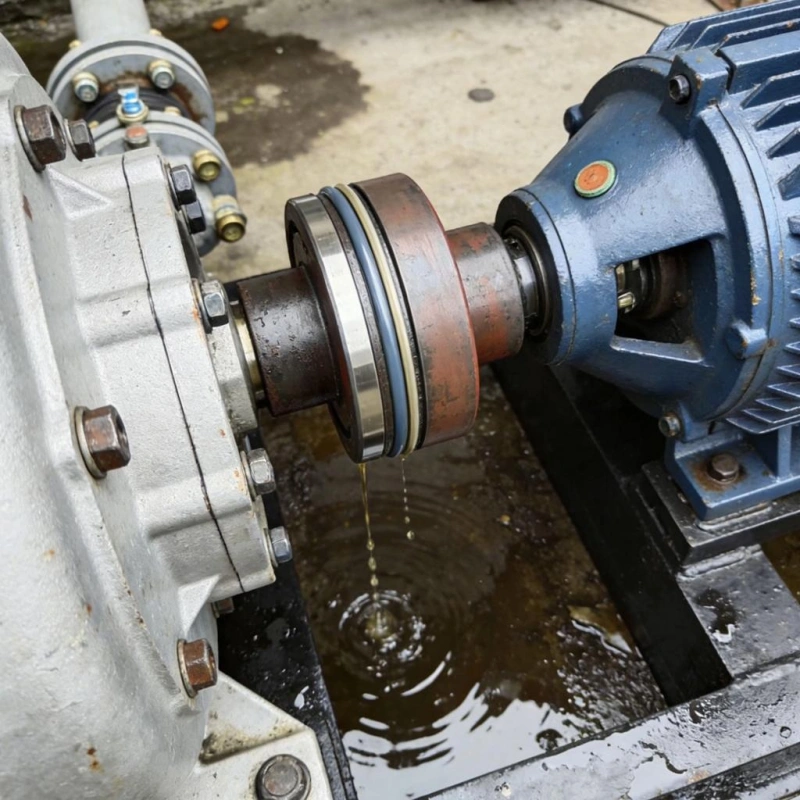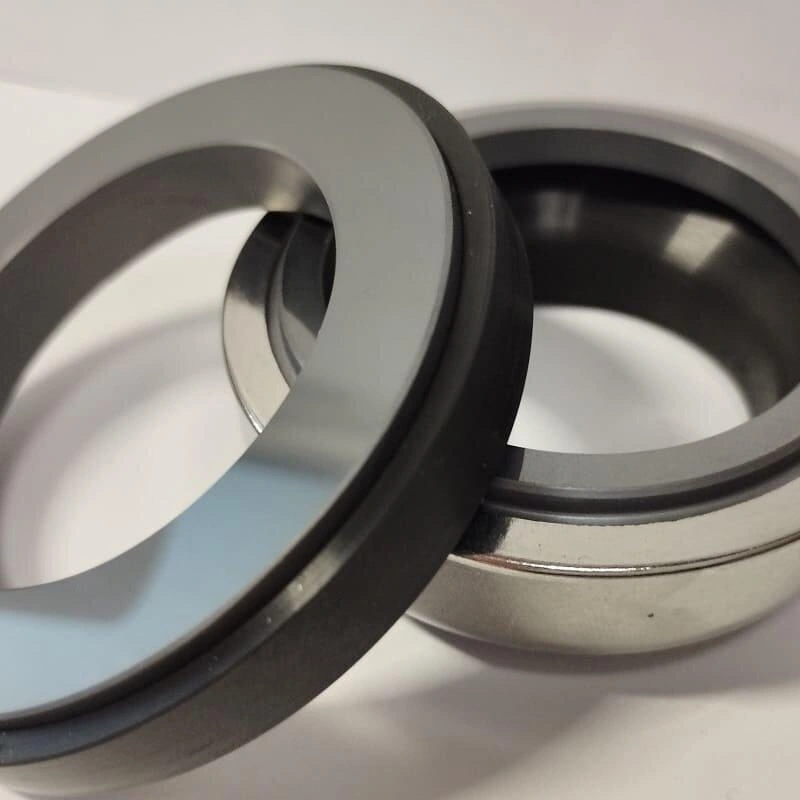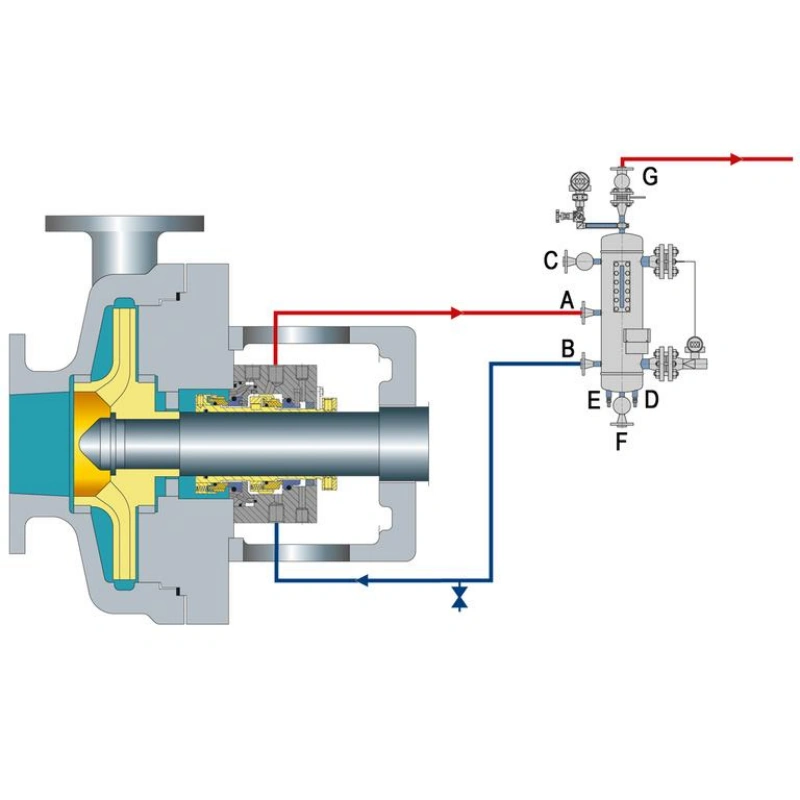

In pumps and other rotating equipment, gland packing and mechanical seals are two common types of shaft seals. Both are used to control leakage of the medium along the rotating shaft, but there are distinct differences between them.
Which one is right for you?
This article will begin by examining the operating principles and structural differences between the two, then provide a detailed comparison of their leakage performance, energy consumption, shaft wear, maintenance costs, and service life. It will analyze how pressure, temperature, rotational speed, and media containing particles affect seal selection. This analysis will help you make a more informed choice between gland packing and mechanical seals based on your specific operating conditions.
The difference between gland packing and mechanical seals lies in the different sealing methods they use to control media leakage around a rotating shaft.
Gland packing primarily relies on radial contact between the packing and the shaft or shaft sleeve to achieve a seal. Mechanical seals, on the other hand, rely on the axial face-to-face fit between the rotating ring and the stationary ring to control leakage.
| Comparison | Gland Packing | Mechanical Seal |
|---|---|---|
| Sealing Principle | Compresses packing against the shaft or sleeve to restrict leakage. | Uses precision contact between rotating and stationary seal faces. |
| Sealing Contact | Packing against the shaft or sleeve circumference. | Axial faces of the rotating and stationary rings. |
| Leakage | Traditional pump packing requires controlled leakage for lubrication and cooling. | Lower leakage, but not completely leak-free. |
| Lubrication | Uses process fluid or external flush fluid. | Uses a thin fluid film between seal faces. |
| Friction & Shaft Wear | Higher friction; may wear the shaft sleeve over time. | Lower friction; wear mainly occurs on seal faces. |
| Maintenance | Requires leakage checks, gland adjustment, and packing replacement. | Requires condition monitoring and occasional repair or replacement. |
| Initial Cost | Lower. | Higher. |
| Suitable Applications | Applications allowing controlled leakage, easy maintenance, and low initial cost. | Applications requiring tighter leakage control and less routine adjustment. |
| Main Limitations | Continuous leakage, frequent adjustment, and sleeve wear. | Requires proper installation, lubrication, and material compatibility. |
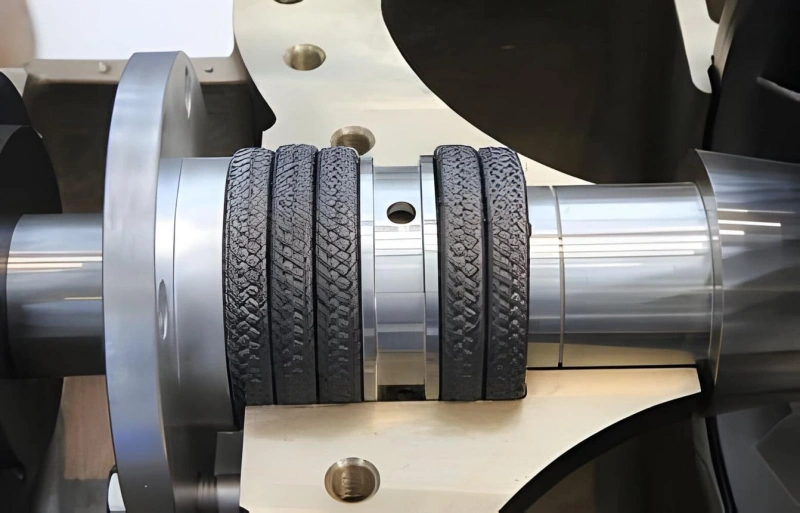
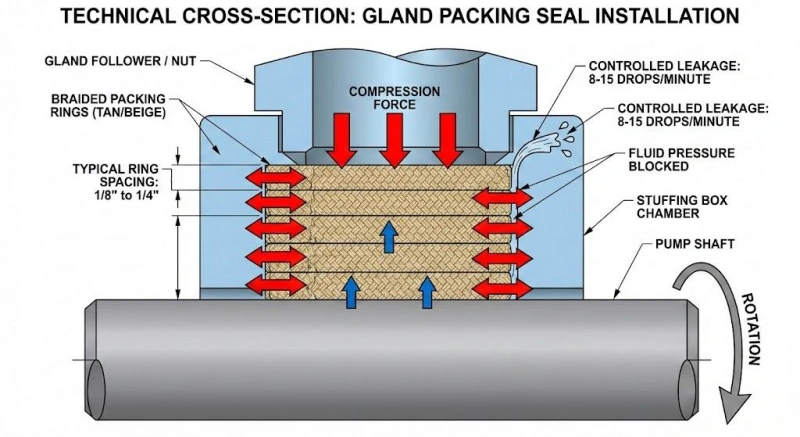
Gland packing, also known as compression packing, is a sealing method that controls media leakage around a rotating shaft by compressing flexible packing. It is typically installed inside a pump’s stuffing box and relies on the contact between the packing and the shaft or shaft sleeve to prevent liquid from flowing out in the axial direction.
A packing seal consists of packing rings, a packing gland, a stuffing box, and gland bolts. It is made of braided fiber material and may contain graphite, PTFE, or other lubricating components.
During installation, place the packing ring into the packing chamber so that it surrounds the pump shaft or shaft sleeve.
As you tighten the gland bolts, the gland compresses the packing axially, causing it to deform and press inward against the shaft sleeve while conforming outward to the inner wall of the packing chamber.
Tip: Do not attempt to achieve a completely leak-free seal simply by tightening the gland; instead, adjust it to the proper sealing condition according to the manufacturer’s specifications.
During pump operation, relative motion between the shaft and the packing generates frictional heat; therefore, the packing seal requires adequate lubrication and cooling. Traditional packing often relies on a small amount of process fluid seeping through to form a lubricating film and dissipate heat—which is why continuous dripping frequently occurs near the gland.
However, not all packing must rely on visible process fluid leakage. Some packing contains built-in lubricants, or lubrication and cooling can be achieved through an external flushing fluid; in such cases, it is essential to ensure that the flushing fluid can properly enter the sealing area.
Tip: When assessing the operating condition of the packing, do not rely solely on the amount of leakage; also conduct a comprehensive inspection of the stuffing box temperature, shaft sleeve wear, and leakage stability. The specific allowable leakage rate must strictly follow the manufacturer’s specifications; a uniform standard based on the number of drops should not be applied.
After the pump has been in operation for some time, the packing may wear out, become compacted, or lose its elasticity, causing the contact pressure to change. At this point, the gland must be adjusted appropriately to restore stable leakage control. If the gland is too loose, contact pressure will be insufficient, leading to increased leakage. If the gland is too tight, it will disrupt lubrication, causing the packing to overheat, harden, or even scratch the shaft sleeve.
For equipment that allows for operational adjustments, the gland should be adjusted in small, uniform increments according to the manufacturer’s specifications, while simultaneously monitoring changes in leakage and temperature.
Tip: Do not tighten the gland significantly in a single step, nor attempt to resolve persistent leakage issues solely by increasing the clamping force. If the packing is severely worn, has lost its elasticity, or if leakage cannot be stably controlled even after adjustment, the unit must be shut down to inspect the packing, shaft sleeve, and other components.
When your pump is handling water or other media suitable for packing material, allows for a certain degree of controlled leakage, and can be inspected and maintained on a regular basis, a packing seal may be a practical option.
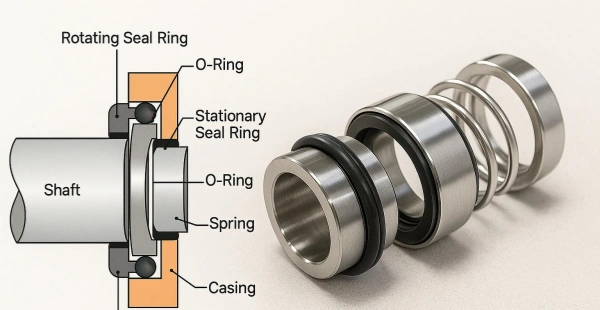
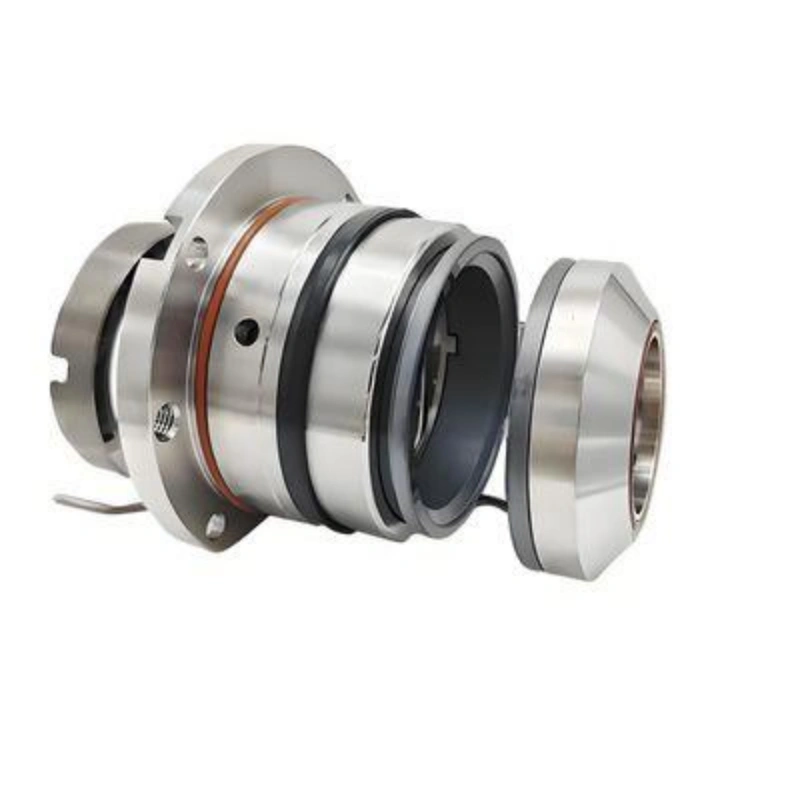
Mechanical Sea is a device that uses two precision-sealed faces to control fluid leakage around a rotating shaft; it is widely used in centrifugal pumps, chemical pumps, and other rotating equipment.
The operating principle is as follows: a seal is formed through the precise fit between a rotating ring and a stationary ring, and an extremely thin fluid film is used to reduce friction and control leakage.
A mechanical seal primarily consists of a rotating ring that rotates with the shaft, a stationary ring that remains fixed, springs, and auxiliary sealing components. When the pump is operating, under the combined action of spring force and fluid pressure, these two precision-machined sealing faces maintain close contact or a very small clearance, thereby limiting fluid leakage.
At the same time, auxiliary sealing components such as O-rings or bellows are responsible for sealing off other potential leakage paths between the sealing rings, the shaft, and the housing.
During operation of a mechanical seal, an extremely thin fluid film typically forms between the two sealing faces to lubricate them and help control friction and heat generation.
This fluid film comes from the process medium being pumped or, depending on the seal configuration and operating conditions, from a dedicated seal lubricant.
Tip: Mechanical seals do not rely solely on the two faces being pressed tightly together to achieve a seal. If you allow the pump to run without sufficient lubrication, dry running may occur, leading to rapid seal failure.
The primary function of elastic loading elements, such as springs, is to provide a closing force at the sealing face and to compensate for sealing face wear and axial position changes. As the sealing face gradually wears down, the elastic elements continue to maintain the sealing face closure within the design limits, preventing immediate seal failure caused by normal wear.
Auxiliary seals, such as O-rings and bellows, are responsible for blocking leakage paths between the rotating ring and the shaft sleeve, as well as between the stationary ring and the gland.
Mechanical seals are the preferred choice when low leakage, minimal adjustment, and stable operating conditions are required. However, if the medium is prone to vaporization or crystallization, or contains a large amount of abrasive particles, standard seals are highly susceptible to failure and require special designs or flushing systems.

Both gland packing and mechanical seals are used to control fluid leakage between the pump shaft and the pump casing, but there are significant differences between the two in terms of sealing principles, leakage control, friction loss, maintenance requirements, and operating costs.
| Comparison | Gland Packing | Mechanical Seal |
|---|---|---|
| Sealing Principle | Compresses packing against the shaft or sleeve to restrict leakage. | Uses precision contact between rotating and stationary seal faces. |
| Sealing Contact | Between packing and the shaft or sleeve circumference. | Between the axial faces of rotating and stationary rings. |
| Leakage Control | Wet packing requires controlled leakage for lubrication and cooling. | Provides lower leakage, but is not completely leak-free. |
| Lubrication | Uses process fluid, external flush, or lubricants within the packing. | Relies on a thin fluid film between seal faces; some designs use external fluids. |
| Friction & Energy | Higher friction; overtightening increases friction losses. | Lower friction, depending on face design and operating conditions. |
| Shaft / Sleeve Wear | Direct contact may cause shaft or sleeve wear over time. | Wear mainly occurs on seal faces, reducing direct shaft contact. |
| Maintenance | Requires leakage checks, gland adjustment, and packing replacement. | Less frequent adjustment; monitor leakage, temperature, and support systems. |
| Installation | Simple structure; requires correct packing installation and gland adjustment. | Requires precise dimensions, clean faces, and careful installation. |
| Pressure Capability | Depends on packing material, stuffing box, and flushing conditions. | Can handle a wide pressure range with suitable designs. |
| Temperature Capability | Depends on packing material, lubrication, and cooling. | Depends on face materials, secondary seals, and cooling. |
| High-Speed Operation | High shaft speed increases friction and heat. | Properly designed seals are better suited to higher shaft speeds. |
| Abrasive Fluids | Wear-resistant packing and flushing can help, but particles may wear the sleeve. | Wear-resistant faces and flushing can help, but particles may damage seal faces. |
| Initial Cost | Lower. | Higher. |
| Long-Term Operating Cost | Includes leakage, packing replacement, sleeve wear, and labor. | Includes seal replacement, support systems, and downtime. |
| Typical Applications | Equipment allowing controlled leakage, easy maintenance, and low initial cost. | Equipment requiring tighter leakage control and less routine adjustment. |
| Main Limitations | Continuous leakage, gland adjustment, friction heat, and sleeve wear. | Sensitive to lubrication, material compatibility, installation, and abnormal operation. |
When comparing gland packing and mechanical seals, leak control is one of the most significant differences. Both are used to prevent the medium inside the pump from leaking outward along the rotating shaft, but there are clear differences in the permissible level of leakage, the risk of leakage, and the environmental impact.
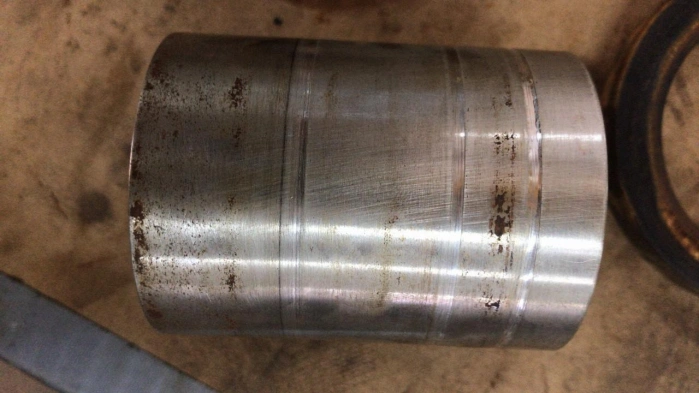
Both gland packing and mechanical seals generate friction during operation, but there are significant differences in the location of the friction, the contact area, and the lubrication conditions.

When comparing gland packing and mechanical seals, you shouldn’t focus solely on the purchase price; you also need to consider routine maintenance, replacement frequency, equipment downtime, and long-term operating costs.
When comparing gland packing and mechanical seals, pressure, temperature, and rotational speed are the three key factors that determine sealing performance and service life.
| Comparison | Gland Packing | Mechanical Seal |
|---|---|---|
| Sealing Principle | Axially compresses packing against the shaft sleeve and stuffing box. | Controls leakage through contact between rotating and stationary seal faces. |
| Pressure Capability | Suitable for low- to medium-pressure service; high pressure requires special packing and gland design. | Suitable for a wide pressure range. Balanced seals reduce net face load in high-pressure service. |
| High-Pressure Limitations | May cause increased leakage, packing extrusion, and friction heat. | Higher face loads may cause friction heat; proper face design and support systems are required. |
| Temperature Capability | PTFE packing can handle approximately 260°C; flexible graphite supports higher temperatures, depending on oxidation and fluid conditions. | Depends on face materials, secondary seals, and cooling. O-rings and other elastomers may limit temperature capability. |
| High-Temperature Limitations | Lubricants and binders may degrade, causing hardening, wear, and reduced sealing performance. | May cause fluid flashing, film breakdown, overheating, thermal cracking, or deformation. |
| Speed Capability | Suitable for low- to medium-speed service; high speed increases friction heat and sleeve wear. | Better suited to higher shaft speeds with proper face loading, materials, and cooling. |
| Reference Speed | Allowable speed varies by packing material. Follow manufacturer ratings. | Standard designs commonly operate below 30 m/s; specialized high-speed designs can reach 100 m/s or more. |
| Combined High Pressure & Speed | Requires careful evaluation of friction heat, lubrication, leakage, and packing life. | Often preferred for evaluation, but face lubrication, loading, and heat dissipation must be verified. |
| Main Limitations | Packing material, gland compression, lubrication, cooling, and shaft sleeve condition. | Face load, face materials, fluid film stability, secondary seals, and support systems. |
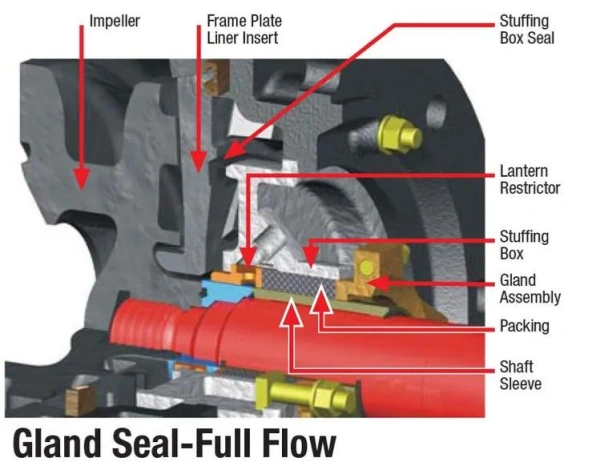
When a pump conveys liquids containing silt, mineral particles, or other solid impurities, both gland packing and mechanical seals may experience wear, clogging, and leakage.
Dirty Fluid vs. Abrasive Fluid: Fluids containing soft sediments or contaminants are not necessarily highly abrasive. Only fluids containing hard particles, such as sand and minerals, are considered typically abrasive.
Packing Seals: Particles enter the gap between the packing and the shaft sleeve, rotating with the shaft and creating a “sandpaper effect,” which accelerates wear on the shaft sleeve and packing.
Mechanical Seals: Particles penetrating the sealing faces cause scratches, wear, and chipping. When deposited on springs or O-rings, they can jam the compensation ring, reducing tracking performance and seal stability.
Advantages: Simple structure, allows for adjustment of the gland, and can be replaced after wear; widely used in mining, wastewater, and slurry equipment.
Key Prerequisite: A clean flushing water supply is required; the flushing fluid is distributed to the packing zone via a liquid seal ring to provide lubrication, cooling, and particle containment.
Applicable Conditions: When the process allows for the dilution of the slurry and the flushing water supply is stable and reliable, soft packing with flushing is the preferred solution.
Seal Face Selection: For applications involving hard particles, hard-on-hard pairings (silicon carbide, tungsten carbide) are recommended; however, high hardness does not necessarily equate to long service life—failure can still occur due to fluid film instability or continuous particle intrusion.
Severe Abrasive Conditions: Prioritize evaluating specialized slurry mechanical seals or double-face seals with pressurized barrier fluid; the barrier fluid pressure must exceed the seal chamber pressure and be compatible with the medium.
Tip: In applications involving particulates, do not immediately switch to a hard-on-hard face seal; first check whether flushing can remove the particulates from the seal chamber. When the flushing water flow is unstable, give priority to cartridge-type slurry mechanical seals or double-face seal configurations. Chipping of the sealing faces is usually not caused by insufficient material hardness, but rather by the liquid film being disrupted by particulates or excessive runout of the mounting surface.

| Application | Why Choose Gland Packing | Suitable Conditions | Key Considerations |
|---|---|---|---|
| 1. Controlled Leakage Is Acceptable | Wet packing requires slight leakage for lubrication and cooling. | Clean water, irrigation pumps, and industrial water pumps. | Ensure leakage can be safely collected or handled. Avoid standard packing for hazardous fluids. |
| 2. Low Initial Cost and Easy Maintenance | Simple design, lower purchase cost, and easy packing replacement. | Budget-conscious equipment with accessible maintenance and low downtime impact. | Consider adjustment, replacement, sleeve wear, and downtime costs. |
| 3. Slurry or Contaminated Fluids | Wear-resistant packing and clean flush fluid can reduce particle ingress. | Sandy water, mineral slurries, and slurry pumps. | Check particle abrasion, flush water quality, and supply. Particles may accelerate sleeve wear. |
| 4. Some Shaft Movement or Operating Variations | Flexible packing can accommodate limited shaft movement. | Some large pumps, slurry pumps, and paper-making equipment. | Do not use packing to compensate for severe misalignment, vibration, or bearing failure. Check manufacturer limits. |
| Application | Why Choose Mechanical Seals | Suitable Conditions / Applications | Key Considerations |
|---|---|---|---|
| 1. Strict Leakage Control | Precision seal faces and a thin fluid film provide lower leakage than traditional packing. | Expensive chemicals, food and beverage, pharmaceutical, and fine chemical applications. | Not zero-leakage. Check lubrication, material compatibility, hygiene, and cleaning requirements. |
| 2. Hazardous or Environmentally Sensitive Fluids | Single or dual seal arrangements with support systems help reduce leakage risks. | Toxic, flammable, volatile, or polluting fluids. Consider Arrangement 2 or Arrangement 3 for high-risk service. | Assess fluid hazards, emission limits, and requirements for collection, monitoring, or isolation. |
| 3. Continuous Pump Operation | Requires less frequent adjustment and can reduce routine maintenance. | Continuous-duty industrial pumps, inaccessible equipment, and high downtime-cost applications. | Ensure proper lubrication, installation, and support system operation. Avoid dry running and excessive vibration. |
| 4. High Pressure or Speed | Balanced designs control face loading, while precision faces and fluid films reduce friction. | Selected high-pressure, high-surface-speed, and continuous high-speed pump applications. | Verify combined pressure, temperature, and speed limits, along with lubrication and cooling. |
| 5. Abrasive or Complex Fluids | Wear-resistant faces such as SiC and WC can be combined with specialized seal designs and support systems. | Sandy water, slurries, crystallizing fluids, and demanding low-leakage applications. | Check particle properties, seal chamber conditions, flush or barrier fluid supply, and face lubrication. |
There is no absolute superiority or inferiority between packing seals and mechanical seals; choosing the wrong one can lead to increased leakage, wear on the shaft sleeve, premature failure, or even safety incidents. The correct sequence is: first, consider the medium and leakage requirements; second, verify the pressure, temperature, rotational speed, and equipment condition; and finally, compare maintenance and long-term costs.
For ordinary, low-hazard liquids where controlled leakage is permitted, packing seals are sufficient. For toxic, flammable, or corrosive liquids, or when strict leakage control is required, mechanical seals are preferred; hazardous media may require double-ended seals combined with an isolation/collection system. Additionally, verify whether the liquid contains particles, is prone to crystallization or vaporization, and assess material chemical compatibility.
Use the actual pressure in the seal chamber and the linear velocity of the shaft surface. For high pressure and high linear velocity, prioritize evaluating mechanical seals, though specialized packing can also withstand higher parameters. Provide normal, start-stop, and abnormal operating conditions to the supplier for confirmation.
Confirm lubrication and cooling conditions in the sealing area; media containing particles or prone to crystallization require a flushing system. Check for shaft runout, sleeve wear, vibration, and bearing condition. If the equipment itself experiences significant vibration or the bearings are faulty, even a high-end mechanical seal will not provide stable performance.
Compare the full range of costs, including procurement, installation, spare parts, labor, media loss, energy consumption, and downtime. Packing is more economical when operating time is short, leakage is acceptable, and maintenance is convenient; mechanical seals are more cost-effective for long-term continuous operation or when the cost of downtime is high.
Traditional wet packing requires a small amount of controlled leakage to lubricate and cool the packing. The specific leakage rate should comply with the manufacturer’s specifications.
It cannot be simply assumed that a mechanical seal is completely leak-free. While it typically leaks less than a traditional gland packing seal, trace leakage may still occur.
Gland packing seals generally require periodic checks of leakage rates, adjustment of the gland, and replacement of the packing. Mechanical seals require less routine adjustment but necessitate monitoring of the face condition and auxiliary systems.
No. Mechanical seals rely on an extremely thin liquid film between the faces for lubrication; a lack of lubrication can lead to dry friction, overheating, and damage to the faces.
Generally, mechanical seals—especially balanced designs—should be evaluated first. However, it is essential to also verify the face load, linear velocity, and lubrication and cooling conditions.
Both can be used with certain abrasive media. Packing seals can be used in conjunction with clean flushing fluids, while mechanical seals require wear-resistant faces and specialized flushing or isolation fluid solutions.
There is no definitive answer. Mechanical seals typically have longer maintenance intervals when properly matched to operating conditions and well-lubricated; packing seals, on the other hand, require regular adjustment and replacement, and their specific service life depends on the medium, rotational speed, and maintenance conditions.
If you need to reduce leakage, minimize routine maintenance, or lower the costs of unplanned downtime, switching to a mechanical seal may be a worthwhile investment. However, you should conduct a comprehensive assessment of procurement costs, installation expenses, maintenance costs, energy consumption, and losses from equipment downtime before deciding whether to make the conversion.
Both packing seals and mechanical seals can prevent leakage around the pump shaft, but they differ significantly in terms of operating principles, leakage rates, friction, maintenance methods, and long-term costs.
When selecting a seal, don’t focus solely on the purchase price or a single parameter. A more prudent approach is to thoroughly evaluate the properties of the medium, the pressure in the seal chamber, temperature, shaft surface speed, lubrication conditions, as well as maintenance and downtime costs.
If you’re still undecided between packing seals and mechanical seals, Sakowitz can help you evaluate suitable seal materials and designs based on the pump type, medium properties, and operating parameters to find a sealing solution that best fits your specific application.
—— We Will Provide You With Professional OEM Solutions.
Whether you require pump bearings, pump valves, mechanical seals, or other custom-engineered components, we support production based on your drawings as well as rapid prototyping.
Please complete the form on the right and upload your technical drawings or specifications. Our engineering team will review your requirements within 24 hours and provide a detailed quotation, application recommendations, and delivery schedule.
Copyright © 2025 Sakowit, All rights reserved.
WhatsApp us