
What is a check valve? Quite simply, it’s a safety guardian. In industrial piping systems, it plays a seemingly simple yet extremely critical role. A check valve allows the medium to flow steadily in only one direction; when any reverse flow is detected, it automatically closes without hesitation, keeping the “risk of backflow” out of the system. Most interestingly, a check valve requires no manual intervention or additional power.
In industrial applications, check valves prevent pump damage caused by reverse rotation, avoid contamination of the fluid in the piping, and reduce the risk of pressure surges and even water hammer. It is precisely because of their presence that systems in water treatment, HVAC, chemical processing, and oil and gas can operate more safely and continuously.
The operating principle of a check valve (non-return valve) is actually very simple: it automatically “opens and closes” based on the fluid pressure differential.
When fluid enters the pipe from the inlet:
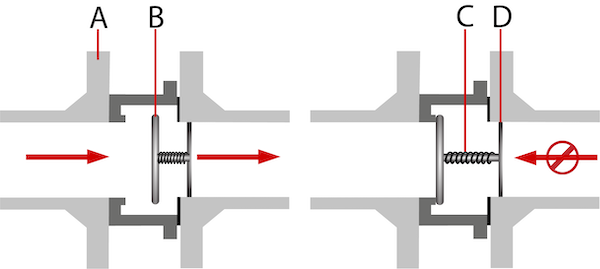
When fluid flow stops or begins to reverse:
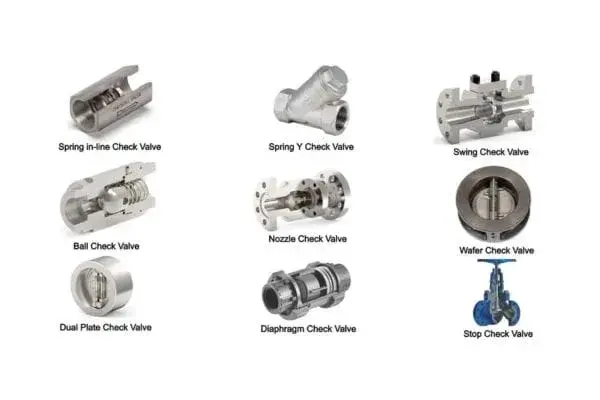
Check valves (non-return valves) can be broadly classified into the following types based on their structural design and operating conditions.
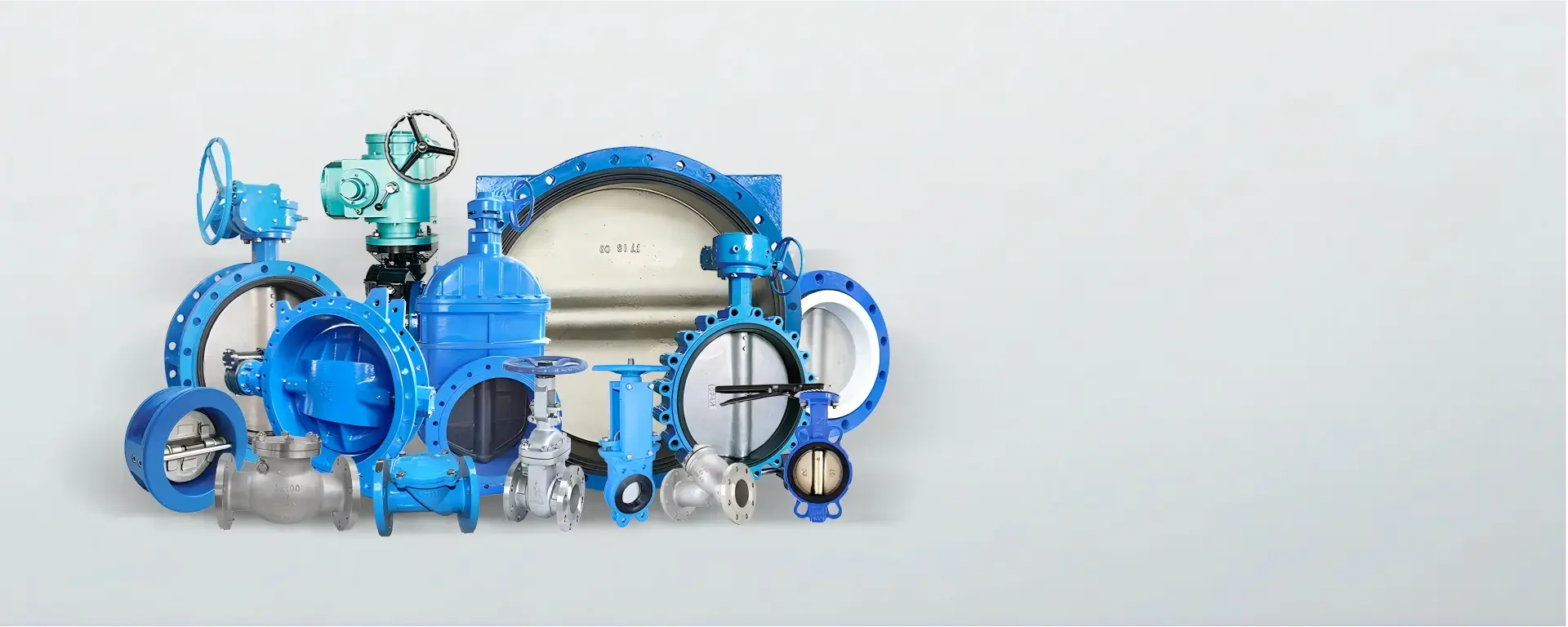
Check valves are used in nearly all fluid systems to prevent backflow, protect equipment, and ensure stable one-direction flow in water, gas, oil, HVAC, and industrial pipelines.
Although check valves have a relatively simple structure, they are indeed indispensable in industrial fluid systems. Their greatest value lies not in “control,” but in quietly protecting the system from malfunctions.
The primary function of a check valve is to prevent reverse flow of fluid in a pipeline, ensuring that the medium always flows steadily in one direction, thereby protecting the safety and stability of pumps, compressors, and the entire system.
It is typically installed at the outlet of a pump, the outlet of a compressor, or any location where backflow needs to be prevented, ensuring that the system does not experience backflow during shutdowns or pressure fluctuations.
Yes. Common causes of failure include jamming due to contaminants, wear on the sealing surfaces, spring fatigue, or improper sizing, all of which can lead to leakage or failure to close properly.
Water hammer is typically caused by pressure surges resulting from the valve closing too quickly or sudden changes in flow velocity. Selecting the appropriate type of check valve (such as a spring-loaded or silent check valve) can effectively reduce this risk.
It depends on the structural type. Some check valves (such as spring-loaded and ball-type) support installation in any direction, while swing-type valves typically require horizontal installation.
As a professional industrial check valves manufacturer , Sakowitz specializes in providing highly reliable, long-lasting fluid control solutions to customers worldwide. From product design and material selection to precision manufacturing and rigorous testing, every step of the process is centered on “stability and safety.”
With our proven production system and engineering expertise, we are able to provide both standardized and customized check valve solutions for industries such as water treatment, HVAC, chemicals, oil and gas, and industrial equipment.
—— We Will Provide You With Professional OEM Solutions.
Whether you require pump bearings, pump valves, mechanical seals, or other custom-engineered components, we support production based on your drawings as well as rapid prototyping.
Please complete the form on the right and upload your technical drawings or specifications. Our engineering team will review your requirements within 24 hours and provide a detailed quotation, application recommendations, and delivery schedule.
جميع الحقوق محفوظة © 2025 جميع الحقوق محفوظة.
واتساب لنا
 Arabic
  English
  Portuguese
  Russian
  Spanish