
Selecting the appropriate check valve for sewage pumps is critical to prevent wastewater back flow, pump short cycles, clogging, odor issues, and premature wear. If wastewater reverses into the sewage tank after the pump stops, the check valve is one of the primary components to inspect.Missing, blocked, damaged, oversized, or incorrectly installed valves can cause wastewater back flow, frequent pump cycling, odors, water hammer, leaks, and premature pump failure.
For you, a suitable sewage pump check valve is not merely a piping accessory but a critical component that determines system reliability and long-term operational costs. Selecting the right valve is essential for ensuring safe, reliable, and easy-to-maintain wastewater discharge.
In this guide, we will explain the working principle of sewage pump check valves, their installation locations, the consequences of their absence, how to select the appropriate type, and the factors you should consider before purchase.
Do you truly understand what a sewage pump check valve is? On the market, it is defined as a one-way valve specifically designed for sewage pumps or sewage jet pump systems. It allows wastewater to flow out through the discharge pipe while preventing back flow into the sewage tank after the pump has stopped. Rather than a simple pipeline accessory, it is a critical component that determines anti-back flow performance, drainage efficiency, odor control, and pump lifespan in sewage lifting systems.
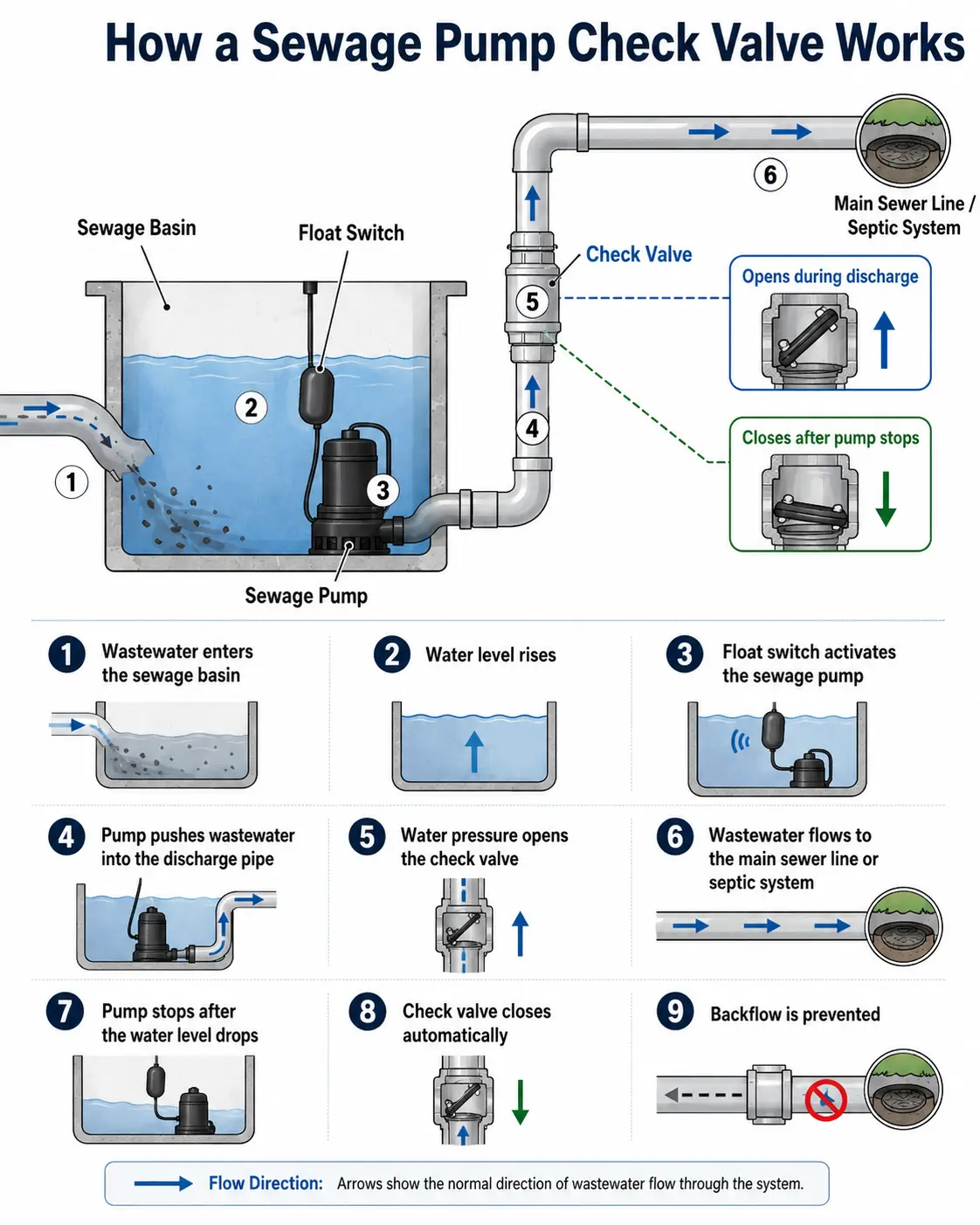
Do you think the working principle of a sewage pump check valve is complicated? In fact, it is quite simple: During pumping, water pressure opens the valve disc to discharge wastewater; when pumping stops, the disc closes automatically to prevent back flow into the sewer or collection tank.
How does the check valve in a sewage pump operate? When wastewater enters the sewage basin, the rising water level triggers the float switch, activating the pump. The pump pushes wastewater into the drainage pipe, where pressure opens the check valve disc or flap, allowing flow into the main sewer system.
When the water level drops and the pump stops, pipeline pressure decreases, and the check valve closes automatically to prevent residual wastewater back flow into the pit.This mechanism reduces wastewater back flow, frequent pump startups and shutdowns, odor risks, and premature pump wear.
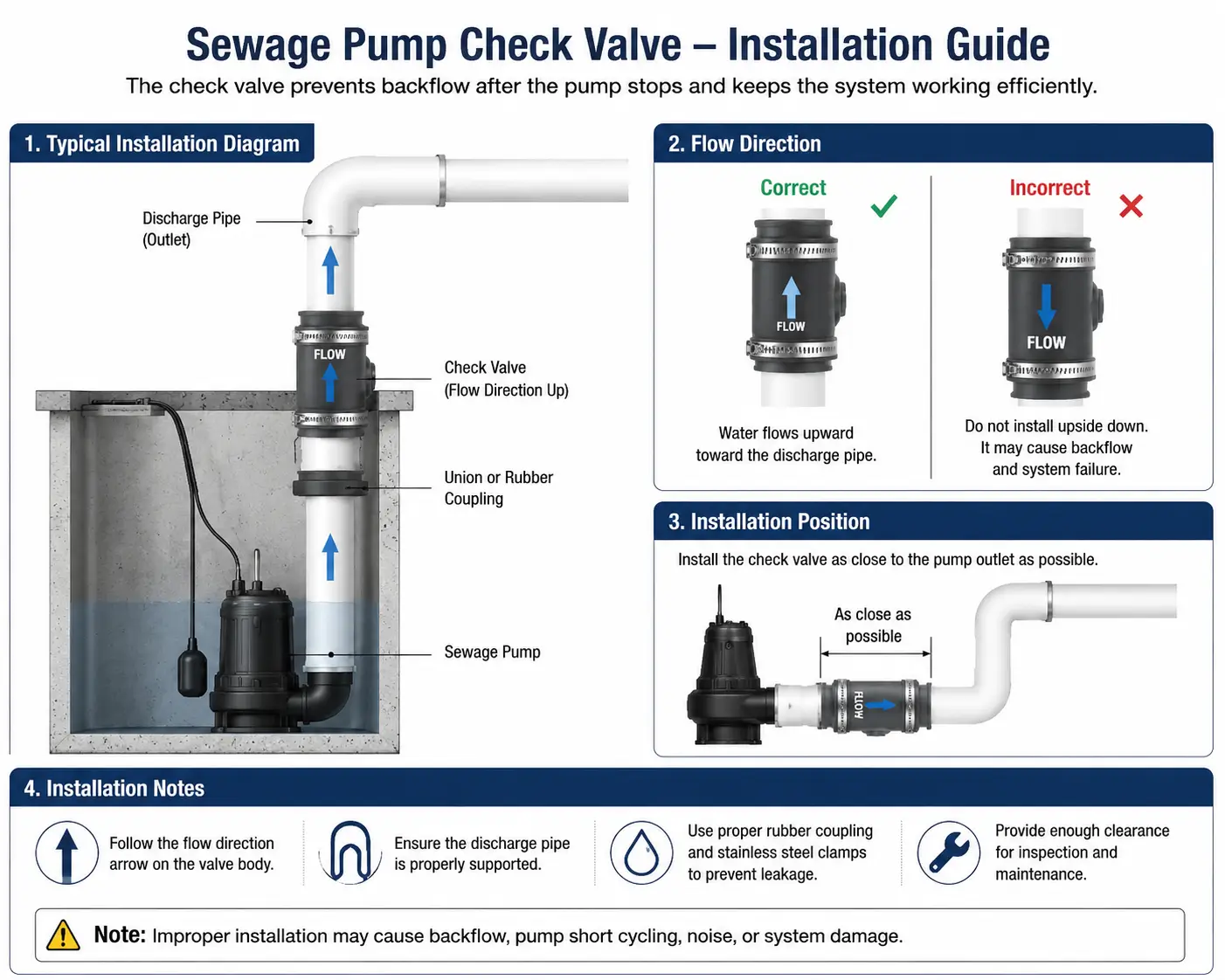
The installation location of a sewage pump check valve has been thoroughly studied; it is typically installed on the discharge pipeline of the sewage pump, above the sewage basin. Please note the following key considerations when installing this valve:
Common installation location errors include:
| Incorrect Installation Method | Possible Consequences |
|---|---|
| Installed on the water inlet pipe | Cannot prevent sewage backflow in the drainage pipe. |
| Reverse direction | The sewage pump is not functioning properly to discharge water. |
| Installation height is too high | Wastewater below the valve will still flow back, causing short cycling. |
| Installation is too low | Checking, cleaning, and replacement become difficult. |
| No maintenance space available | The maintenance costs in the long term are high. |
| No detachable structure included | The tube may need to be cut during replacement. |
| Replace the sewage valve with a standard sump pump valve | May not be suitable for wastewater and solid particles. |
| Not installed according to the manufacturer's instructions | Affects system reliability and warranty coverage. |
For professional installation, check valves are typically used in conjunction with globe valves, union fittings, rubber unions, or stainless steel clamps to facilitate maintenance.
Are you aware of the consequences of lacking a sewage pump check valve on your system? Without this valve, wastewater remaining in the drainage pipe after pump shutdown may flow back into the sewage tank. Such back flow can cause water levels to rise again, leading to frequent pump startups and shutdowns. The absence of a sewage pump check valve results in the following issues:
| Consequence | Specific Impact |
|---|---|
| Sewage Backflow | The residual wastewater in the drainage pipe will flow back into the sewage basin. |
| Pump Short Cycling | Reflow causes the water level to rise again, triggering the float switch repeatedly. |
| Premature Pump Wear | Frequent motor startups increase heat generation and mechanical strain. |
| Lower Discharge Efficiency | The water pump repeatedly draws the same portion of wastewater. |
| Higher Energy Use | Frequent operation leads to unnecessary power consumption. |
| Odor Risk | Wastewater reflux or retention may increase sewer odors. |
| Contamination Risk | Back flow of wastewater may lead to hygiene and sanitation issues. |
| Higher Maintenance Cost | More prone to issues requiring rework, cleaning, repair, or replacement. |
With the wide variety of sewage pump check valves available on the market, how should you make your choice? When selecting a sewage pump check valve, you need to consider multiple factors, as a suitable one can significantly benefit your operations. Here are the key considerations you should know:
When selecting a sewage pump check valve, the pipeline dimensions must match both the pump outlet dimensions and the drainage pipe dimensions. An improperly sized check valve will significantly compromise drainage efficiency. An undersized valve may restrict flow and increase clogging risk, while an oversized valve may reduce flow velocity and impair wastewater discharge performance.Common sizes for sewage pump check valves include:
| Common Sizes | Applicable Scene | Selection Recommendations |
|---|---|---|
| 1-1/2 inch | Small wastewater systems, lightweight drainage applications | Suitable for systems with low flow rates; verify the pump outlet size before use. |
| 2 inch | Common residential sewage ejector pump systems | One of the most common specifications, suitable for basement bathrooms and laundry wastewater lifting systems. |
| 3 inch | High-flow sewage pump or commercial wastewater discharge systems | Suitable for applications requiring higher flow rates and greater drainage loads. |
| 4 inch | Engineering, commercial, or large-scale wastewater discharge systems | Suitable for systems with higher flow capacity, typically used in professional engineering or commercial projects. |
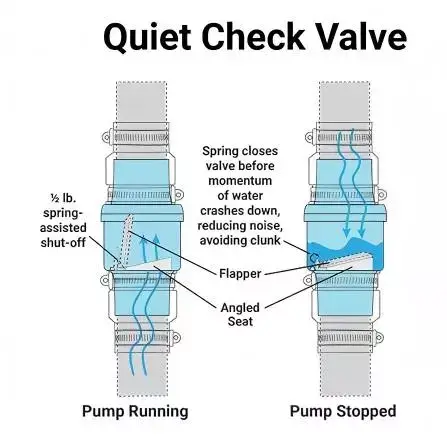
When selecting a sewage pump check valve based on noise requirements, you should consider how the valve closes after the pump stops. A standard gravity-closing valve may provide basic back flow prevention, but in some systems it can cause valve impact, water hammer noise, or pipeline vibration.
For noise-sensitive applications, silent sewage check valves or spring-loaded check valves are typically the preferred choice. The spring-assisted design ensures smoother valve closure before back flow occurs. Selecting a silent or spring-loaded check valve can help reduce after-sales complaints and enhance installation satisfaction.
When selecting a sewage pump check valve based on maintenance convenience, you should consider whether the valve is easy to inspect, clean, disassemble, and replace. For installations requiring simplified maintenance, union check valves or rubber joint check valves are typically the preferred choice. These designs enable plumbers to remove the valve more easily, thereby reducing service time, labor costs, and customer complaints.
When selecting a sewage pump check valve based on material requirements and durability, you must consider the operating environment of the sewage pump system. Since the valve may come into contact with wastewater, moisture, debris, and potential chemical residues, the material must exhibit stable corrosion resistance, excellent sealing performance, and long-term durability. Common valve body materials include PVC, ABS, polypropylene, transparent plastics, and cast iron.
Durability also depends on internal components and connections, including discs, seats, rubber seals, springs, rubber joints, and stainless steel seats.Selecting durable materials can reduce issues such as leakage, back flow, odor emissions, maintenance frequency, and after-sales complaints.
When buying a sewage pump check valve, consider more than price and basic pipe size; ensure it matches pipe size, flow rate, connection type, and wastewater conditions.
You should also evaluate the material’s durability, sealing performance, and anti-back flow capability. For noise-sensitive systems, a silent or spring-loaded sewage check valve can help reduce valve impacts and water hammer effects. Before purchasing, verify the availability of commonly used sizes and OEM packaging options.
Selecting the right sewage pump check valve prevents wastewater back flow, reduces pump short cycling, improves discharge efficiency, and protects the pump from premature wear.
If you’re looking for the right sewage pump check valve, please provide your required dimensions, valve type, connection method, packaging requirements, and application conditions. We can recommend a more suitable valve for your needs.
—— We Will Provide You With Professional OEM Solutions.
Whether you require pump bearings, pump valves, mechanical seals, or other custom-engineered components, we support production based on your drawings as well as rapid prototyping.
Please complete the form on the right and upload your technical drawings or specifications. Our engineering team will review your requirements within 24 hours and provide a detailed quotation, application recommendations, and delivery schedule.
Copyright © 2025 Sakowit, Todos os direitos reservados.
 Portuguese
  English
  Russian
  Arabic
  Spanish